Every Mercedes owner eventually gets the message on the dash: Service A due, or Service B. Almost nobody is told what separates them, and the assumption at the counter is usually that B is just A with a bigger invoice attached. It is not. They are two different lists, and knowing which items live on each one is what lets you plan instead of react.
Here is what a Mercedes Service A and Service B in Brisbane should cover, what the ASSYST counter is actually measuring, and the three items that sit outside both lists and get missed.
The counter is measuring work, not distance
Mercedes has not used a fixed kilometre interval for a long time. ASSYST watches how the car is being used: engine operating hours, oil temperature over time, cold starts, revs and load. From that it calculates how hard the oil has actually worked and counts down to the next service.
Which is why two identical C-Class sedans in Brisbane can be due at completely different readings. One doing a weekly run down the Bruce Highway has oil that has barely aged. One doing school runs around Ascot and Hamilton, never reaching full operating temperature, is working its oil far harder per kilometre, and the counter reflects that.
There is also a time cap. Whatever the counter says, a year is a year, because oil degrades with age and moisture as well as use. In a Brisbane summer, where the humidity does not let up for months, that matters more than it does further south.
Service A: the shorter list
Typically the first scheduled visit, around a year or 25,000 km, whichever the car reaches first.
- Engine oil and filter, to the exact Mercedes approval for your engine.
- Cabin dust filter.
- All fluid levels checked and corrected.
- Tyres: pressures, condition and wear pattern, not just a glance at tread depth.
- Brake components inspected, with pad material measured rather than estimated.
- ASSYST reset through the diagnostic system, and the service written digitally against the VIN.
Service B: everything in A, plus what goes by time
- The whole of Service A.
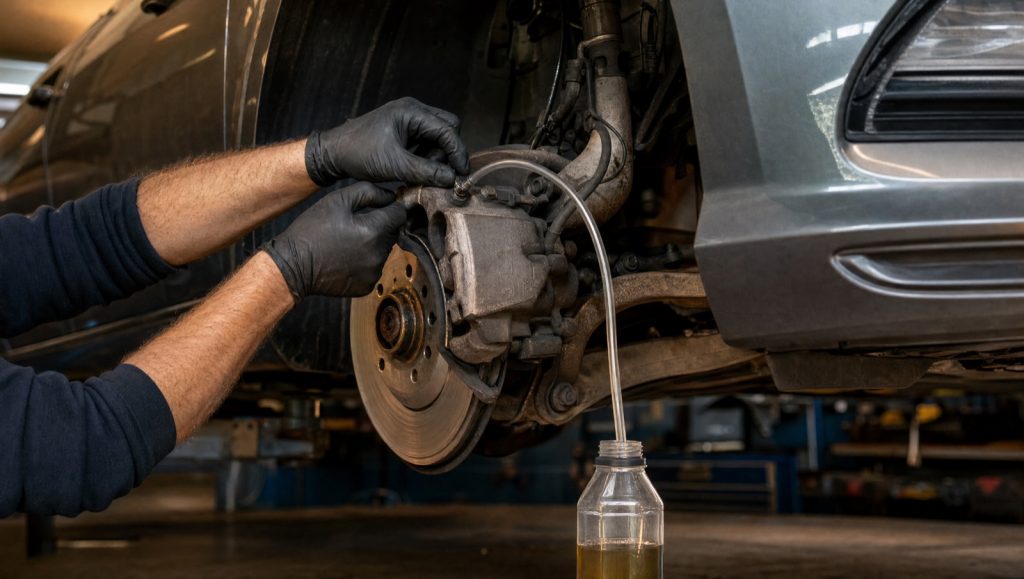
- Brake fluid. Every two years without exception. It absorbs moisture from the air and moisture lowers the boiling point, which is a hot-climate problem more than a cold one.
- Air filter, on schedule rather than on condition.
- A deeper inspection: suspension, steering, exhaust, drive shafts, cooling system and the underside of the car.
- Full fault memory read across every module.
After that the pattern alternates, A then B, with extra items appearing at specific ages: spark plugs, transmission service, and on diesels the fuel filter and particulate filter checks.
The three items that sit outside both lists
Transmission service. The 7G and 9G automatics take fluid, a filter and a sump gasket, and they have an interval, despite the “sealed for life” label the industry attached to these boxes years ago. A car that shifts harshly at low speed with no transmission service in its history is not a mystery, it is a maintenance item that was skipped.
Spark plugs. Interval varies by engine. On the V6 and V8 the labour is a real part of the cost, which is why it belongs in a planned visit rather than an emergency one.
Coolant. Long-life, not lifetime. It loses its corrosion inhibitors over years, and what it protects costs considerably more than the fluid does.
What Brisbane does to the schedule
Three local factors change how these cars age, and none of them appear in the manufacturer’s assumptions.
Heat. Sustained high ambient temperature is hard on batteries, on rubber and on any fluid with a service life. A Mercedes battery here is doing well to reach five years, and the car will disable convenience functions long before it refuses to start.
Humidity. Brake fluid absorbs moisture from the air. That process does not care how far you drove, and it runs faster in a climate like ours. The two-year interval on Service B is not a suggestion here.
Short trips. The inner north is a short-trip suburb. An engine that never reaches full operating temperature does not boil the condensation out of its oil, which is exactly the pattern that makes ASSYST count down faster.
What we watch, model by model
C-Class and E-Class. Reliable, and the thing to watch is the transmission service history. On older cars, front suspension bushes give a knock over speed humps that owners tend to live with for a year.
GLC and GLE. Heavier, so harder on brakes and tyres. On air-suspension variants the first symptom of trouble is a car sitting low after a night in the garage, and ignoring it takes the compressor with it. There is more on that on our suspension page.
Diesels. The particulate filter needs sustained driving to complete a regeneration. A car doing short runs around Albion and Newstead accumulates soot faster than it burns off, and the first sign is often an oil level that appears to be rising, because unburnt fuel is finding its way into the sump. We check filter load and oil dilution at every diesel service.
AMG. Different fluids, a different brake wear curve and usually a shorter oil interval. Tell us the exact model when you book, because the parts ordered the day before are not the same.
What the counter cannot see
ASSYST is calculating oil life and calendar. It knows nothing about your brake pads, your tyres, your suspension bushes or a coolant leak that has not yet shown itself on the driveway.
So the visit matters more than the number. Every Mercedes that comes through here gets brake material measured with a gauge, battery state of health tested under load rather than read as voltage, a cooling system pressure test, and a full fault memory read including the stored intermittent faults that have not lit anything up yet. You get those results whether or not there is anything to act on.
The warranty question, answered plainly
Under Australian Consumer Law a manufacturer cannot require you to service at their dealership to keep a factory warranty valid. What they can require is the manufacturer’s schedule, parts that meet specification, work by someone qualified, and documentation.
That is how we work: the correct A or B list for the car in front of us, genuine or OE parts with the numbers on the invoice, fluids to the exact Mercedes approval, the ASSYST reset done properly through the diagnostic system, and the service written to the vehicle. Every job also carries our own 1 year / 10,000 km workshop guarantee on top of your factory cover.
Independent, not the dealership
The dealership and an independent specialist start from the same document: the Mercedes operation list for Service A or B on your model. Where they differ is in what happens around it. A dealership quote is usually the full package for that letter. Ours starts from the ASSYST reading and the car on the hoist, so items that are due go on the quote and items that are not stay off it, with the measurement written beside them so you can see why.
The other difference is who you talk to. At an independent workshop the technician who reads your car explains what was found, rather than a message relayed through a service desk. If the transmission has no service in its history, or the brake fluid date has passed, you hear it from the person who looked.
Two things still belong at the dealership. Recalls and repairs under the factory warranty are done there at no cost to you, and if we find an open recall on your car we will tell you so you can book it in. Everything else on the A and B lists is ordinary maintenance, and Australian Consumer Law lets you choose who does it.
How to read the service message on your dash
The message usually comes as a letter and a number, such as “Service A in 30 days” or “Service B due”, and on many models a plus sign and extra codes. The letter is the list. The number is the countdown, in days or kilometres, whichever ASSYST expects to reach first. The extra codes are the additional items that have become due on that visit, such as brake fluid, the air filter or the transmission service.
If you send us a photo of that screen when you book, we can tell you before you arrive which items are included and which parts we need to order. It removes the guesswork from the quote, and it means the car is not waiting a day for a filter that could have been on the shelf.
Booking it in Albion
We are an independent European workshop at 21 Pedder St, Albion, ten minutes from Ascot, Hamilton and Newstead, and not a dealership. By appointment only, so your car gets a technician rather than a queue position.
If you are not sure whether the car is due for A or B, bring it in and we will read the counter rather than guess. It takes minutes. Tell us the model, year and engine when you book so the right parts are on the shelf, and the full list of what we do is on the Brisbane services page.
Common questions
How do I know if I need Service A or Service B?
The car knows. The ASSYST display tells you, and we read it from the diagnostic system when you arrive rather than assuming from the odometer.
My car does very few kilometres. Can I skip a year?
No. The annual cap exists because oil degrades with time and moisture, and in this climate brake fluid absorbs water whether the car moves or not.
Does the automatic transmission really need servicing?
Yes. Fluid, filter and gasket on the 7G and 9G, on their own interval. It is the item most often missing from a Mercedes history and the most expensive one to ignore.
Will you stamp the service book?
Where there is still a book, yes, and the service is also written digitally against the VIN, which is what a buyer’s inspector reads years later.
What do the extra numbers after Service A or B mean?
They are additional items that have become due on that visit, such as brake fluid, the air filter or the transmission service. Send us a photo of the message and we will tell you exactly what they are for your model.