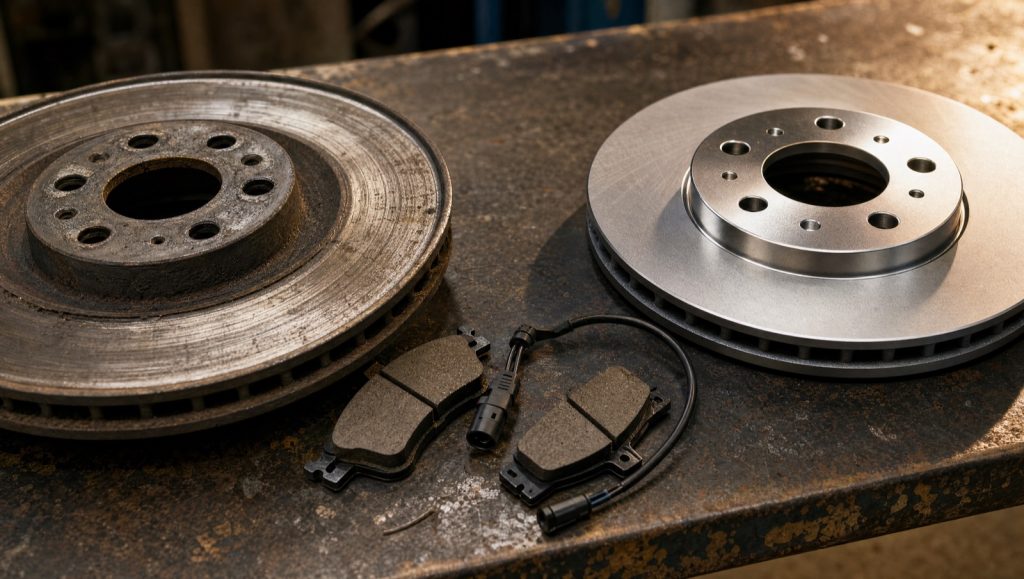
The most common complaint we hear about brake work done elsewhere is not the price. It is that the dashboard warning came back a week or two after the job was finished. That happens for one specific reason, and it points at everything else people get wrong about brakes on a European car.
Here is what a proper brake job includes, what gets measured before a quote leaves the counter, and where the cheap version cuts.
Four wearing parts, not one
A brake corner has pads, a disc, a fluid and, on most European cars, a wear sensor. All four have a service life and they do not run out together.
Pads are the obvious one and the cheapest.
Discs carry a minimum thickness stamped into them by the manufacturer. A disc under that figure is neither legal nor safe, however new the pads on it are. European cars deliberately use softer discs than many Japanese equivalents, because the pad compound and the disc are engineered as a pair, and that is why so many arrive here needing both at once.
Brake fluid goes by time, not distance, because it absorbs moisture from the air. Two years is the interval on nearly every European car, and in this climate the humidity means that is a floor rather than a guideline.
Wear sensors are consumables: a wire loop the pad grinds through to trigger the dashboard warning. Once triggered, that sensor is finished.
Why the light comes back
Because the sensor was reused. It had already been ground through, which is what produced the original warning, and refitting it into a new pad only delays the same message. Sometimes it is worse: the circuit is damaged and the car now reads an open circuit rather than a worn pad.
Sensors are not expensive. Leaving them off a quote makes the number look better and makes the job wrong.
What we measure before quoting
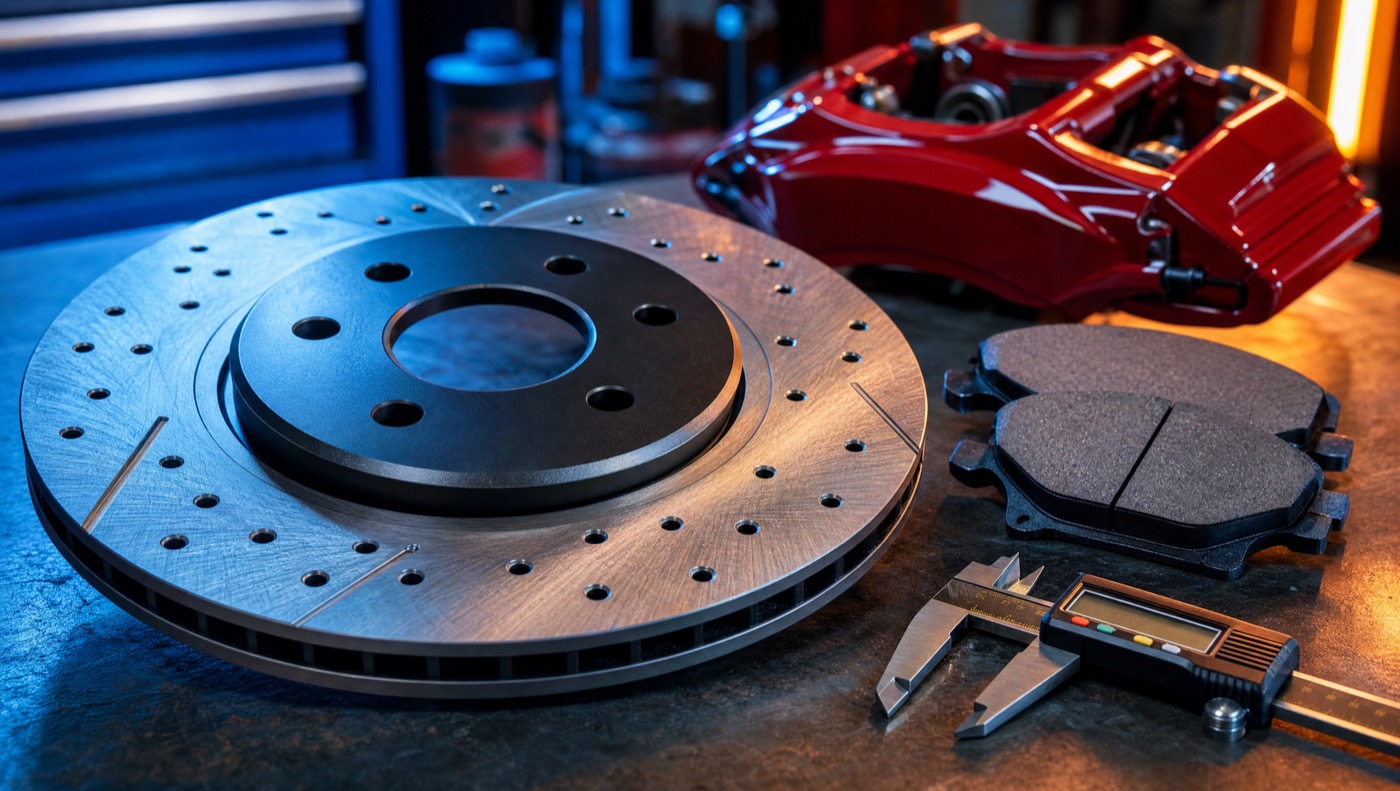
Nobody should be told their brakes are “due” without a number attached. Four things get measured before a quote leaves here.
- Pad material remaining, in millimetres, front and rear, with a gauge.
- Disc thickness, against the minimum for that part, plus a check for lipping and heat cracking.
- Runout, if there is pulsing through the pedal, because a warped disc and a sticking caliper feel similar and are different repairs.
- Fluid condition, tested rather than looked at.
Those numbers go on the report. If your pads have five millimetres left, we will tell you they have another interval in them.
The electronic parking brake changes the job
If your car has a button rather than a lever, the rear caliper pistons are motor-driven and must be retracted through the diagnostic system before pads can be replaced. Wind them back mechanically, the way you would on an older car, and the actuator is damaged.
This is the clearest line between a workshop that can service your car and one that cannot, and it is why a rear brake job on a European car costs more than the front. It is not the parts, it is the software and the procedure. Afterwards the system has to be recalibrated and the pads bedded properly, because a first hard stop on unbedded pads glazes them and produces the squeal owners then blame on cheap parts.
What Brisbane driving does to brakes
Stop-start on Sandgate Road and Kingsford Smith Drive is brake driving. A car doing school runs and a city commute around the inner north uses its brakes far more per kilometre than the same car on a highway run, and the cars themselves have got heavier over the last decade.
Humidity adds a second effect that is easy to misread. Surface rust forms on discs overnight in this climate, particularly on a car parked outside, and the first few stops of the morning scrub it off with a noise that sounds alarming and means nothing. What is not harmless is a car that sits unused for weeks: that surface rust pits, and a pitted disc will pulse under braking long after the rust looks gone.
Noise, and what each kind means
A squeal that comes and goes with the weather is usually that overnight surface rust, and it is not a fault.
A constant squeal under light braking points at glazing, hardware needing cleaning, or pads that are finished.
A grinding sound is metal on metal. The friction material is gone and the backing plate is cutting the disc. Every kilometre in that state adds a disc to the bill.
A knock over bumps that stops when you brake is usually loose hardware or a worn anti-rattle clip.
Pulsing through the pedal is disc runout or a caliper not releasing evenly, and it is worth diagnosing rather than replacing on suspicion, because the two feel identical and cost differently.
Parts: genuine, OE, and the category to avoid
Genuine parts come in a manufacturer box. OE parts come from the company that made the genuine ones, in their own box, usually at a lower price. Both are correct.
The third category is aftermarket pads chosen on price alone, and that is where European cars get let down. The wrong compound produces dust, noise, poor cold bite and accelerated disc wear, and the saving disappears within months. We fit genuine or OE and put the part numbers on the invoice.
How long it takes, and why that varies
One axle, pads and discs, on a car with a conventional handbrake is a half day. The same job on a car with an electronic parking brake takes longer, because retracting and recalibrating the actuators is a procedure rather than a spanner.
Add fluid and it becomes a full day, because a proper fluid change is not a top-up: old fluid is pushed out of every corner in sequence, including the ABS unit where the car requires it, until what comes out is clean. Rushing that is how air ends up in a circuit and a pedal goes soft a week later.
We tell you which of those your car is before you leave it, not at four in the afternoon.
After the job: the bedding-in week
New pads and discs need bedding. A series of moderate stops from moderate speed without coming to a complete halt, then gentle driving to let everything cool evenly. That transfers an even layer of pad material onto the disc face, which is what gives consistent bite.
What ruins it is one hard stop from high speed in the first hundred kilometres, or sitting at a red light with your foot hard on a very hot pedal, which prints a pad-shaped patch onto the disc. That patch is what gets described as a warped disc later. We bed the brakes before the car leaves and tell you what to avoid for the first week.
Booking it in Albion
We are an independent European workshop at 21 Pedder St, Albion, ten minutes from Ascot, Hamilton and Newstead, and not a dealership. If you have noise, a warning light or a pedal that does not feel right, say which when you book and roughly when it happens.
Everything we fit carries our 1 year / 10,000 km workshop guarantee, and the detail is on our brake repairs page. The full list of what we do is on the Brisbane services page.
Common questions
Numbers, not opinions
Every recommendation we make comes with a measurement attached. Brake pad and disc thickness against the manufacturer minimum, tyre tread by corner with the wear pattern noted, battery state of health, coolant strength and any oil seepage photographed.
That is what lets you decide whether to act now or at the next service instead of taking a verdict on trust, and it is what lets us tell you honestly that something can wait.
The numbers go on your report, so the next visit starts from a record rather than from memory.
Booking in Albion
The workshop is at 21 Pedder St, Albion QLD 4010, minutes from Hamilton, Teneriffe, Newstead, Ascot and Clayfield. We are appointment only, so the technician who starts your car finishes it.
Send us the rego and the odometer, or a photo of the service screen, and we will tell you exactly what is due before you commit to anything.
You see the quote before anything is touched, and every job is backed by a twelve month or 10,000 km guarantee.
Do discs always need replacing with pads?
No, and we will not sell them if the measurement says otherwise. On European cars the pairing often does end together, but the number decides, not the habit.
Why did my brake light come back after new pads?
Almost always because the wear sensor was reused. Once the pad has ground through it, that sensor is finished and refitting it only delays the same warning.
How often should brake fluid be changed?
Every two years on nearly every European car, regardless of kilometres. It absorbs moisture from the air, and humidity here makes that faster rather than slower.
My car squeals on the first stop each morning. Is that a problem?
Usually not. Overnight surface rust burning off is normal in this climate. A squeal that stays all day, or a grinding sound at any time, is worth booking in.