The two most common Audi bookings we take are the 60,000 km service and the 90,000 km service, and owners are regularly surprised that the quotes are not close to each other. They are not meant to be. The later interval carries items that come due once, and those items are the difference between an Audi that stays reliable past 200,000 km and one that starts costing money at 150,000.
Here is what each visit includes, in the order the money goes, and what changes if your car is a quattro, a TDI or an S model.
Fixed or flexible: check which one your car is on
Audi runs two regimes. Fixed servicing is every 12 months or 15,000 km, whichever comes first. Flexible, or LongLife, lets the car decide using oil quality sensors and driving data, and on paper it stretches to 24 months or 30,000 km.
Our advice, given before you book: if your Audi lives in Brisbane traffic, use the fixed interval even if the car is set to flexible. LongLife was designed around long, steady driving at consistent temperatures. What it gets here is short runs between Albion, Ascot and the city, high ambient heat for most of the year, and an engine that often never reaches full operating temperature before it is switched off again.
The cost difference across three years is small. The cost of a turbocharger, or a timing chain tensioner on an engine that has been running tired oil, is not.
What the 60,000 km service covers
- Engine oil and filter, to the exact VW/Audi approval for your engine, with the sump plug washer replaced and the filter element and o-rings renewed.
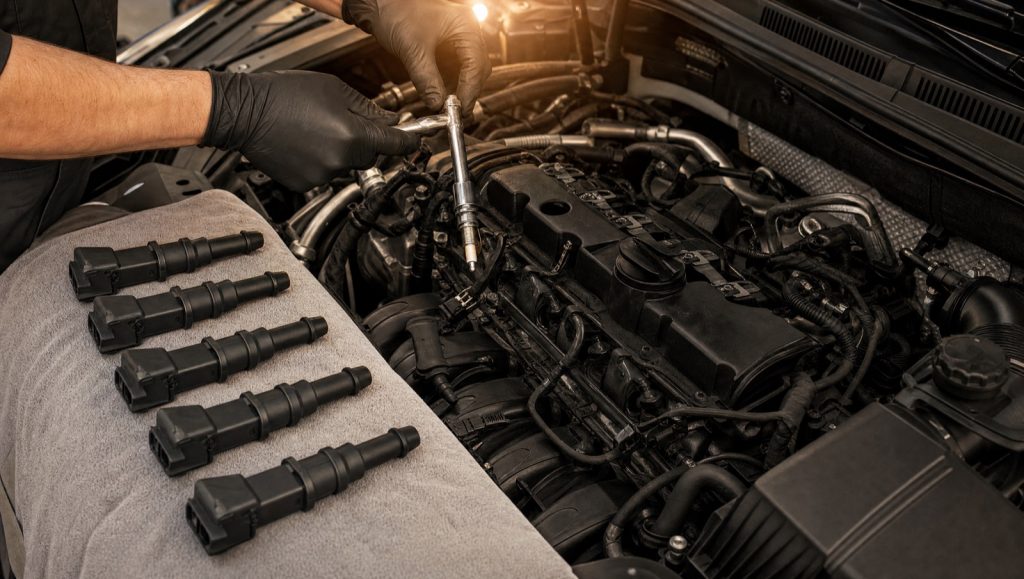
- Spark plugs on most petrol engines. Straightforward on the 2.0 TFSI, longer on the V6, and the quote reflects that.
- Air and cabin filters, replaced on condition. In Brisbane the cabin filter is almost always worse than the owner expects.
- Brake fluid, if it has been two years. Fluid goes by time because it absorbs moisture from the air, and humidity here accelerates that.
- Full fault memory scan across every module, plus the service interval reset done properly through the diagnostic system.

What gets added at 90,000 km
Haldex oil and filter on quattro models that use it. Its own schedule, roughly every 60,000 km, and the single most skipped item we find on an Audi. When the fluid degrades the clutch pack stops engaging cleanly, and the first thing an owner notices is a car that pushes wide out of a wet roundabout in a way it did not last year.
DSG or S tronic service where fitted. Fluid and filter at around 60,000 km on the wet-clutch boxes, with the adaptation values reset afterwards. Skip it and the shudder arrives well before any warning light does. More on that on our transmission page.
Coolant condition and a pressure test. On the 2.0 TFSI family the water pump and thermostat housing are known wear points, and the first sign is a coolant level dropping slowly with nothing visible on the driveway. We pressure test rather than top up and hope.
Carbon build-up on direct injection engines. Fuel never washes the back of the intake valves on these, so deposits accumulate. By this interval many cars show it as a rough cold start or a small loss of response rather than a fault code. We look at live data before recommending anything, because a walnut blast is real money and it should be justified by evidence.
Suspension bushes and drop links. Not scheduled, but this is the age where they start to talk. A knock over a speed hump is worth investigating before it becomes uneven tyre wear.

TDI and S models change the list again
On a diesel the service has a second half petrol owners never think about. The particulate filter relies on regeneration cycles that need sustained driving to complete. A TDI doing short runs around the inner north accumulates soot faster than it can burn off, and the first symptom is usually not a warning light but an oil level that appears to be rising, because unburnt fuel is finding its way into the sump.
We check filter load and oil dilution at every diesel service, and if the numbers are heading the wrong way we tell you what driving pattern fixes it before you spend money on parts. Sometimes the answer is one longer run a fortnight rather than a repair.
S and RS models change the fluids, the brake wear curve and often the gearbox schedule. Tell us the exact model when you book, because the parts we order the day before are not the same.
The four checks we do regardless of interval
Every Audi that comes through here gets these, because they are cheap to check and expensive to miss.
Battery state of health under load, not voltage at rest. A battery reading 12.6 volts can still be finished, and in this climate four to five years is a good run. On any modern Audi a replacement also has to be registered to the car, or the charging strategy keeps working to the old battery’s age and the new one dies early.
Cooling system pressure test, for the reason above.
Brake material measured with a gauge, front and rear, and the number written on the report. If your pads have five millimetres left we will tell you they have another interval in them rather than sell you a brake job.
Full fault memory read, including stored intermittent faults that have not lit anything up yet. That is where the next problem announces itself months early.
The three questions owners ask at the counter
“Can I do the oil now and the rest later?” Yes, and sometimes that is right. What we will not do is split it without telling you what you are deferring. If the haldex oil is four years old, saying so and letting you decide is the job.
“The dealer quoted more. What am I not getting?” Usually nothing on the work: same schedule, same approvals, same diagnostic access. What changes is the labour rate. What should never change is the parts specification, which is why our invoice carries part numbers rather than descriptions.
“How do I know the last service was actually done?” Read the car. Service data is written against the VIN, and any workshop with the right software can show it on screen. When a folder of invoices and the vehicle record disagree, the car is telling the truth, and that gap costs money on the day you sell.
Warranty, in one paragraph
Under Australian Consumer Law a manufacturer cannot require you to service at their dealership to keep your factory warranty valid. They can require the manufacturer’s schedule, parts to specification, qualified work and documentation. That is exactly how we work, and every job also carries our own 1 year / 10,000 km workshop guarantee on top of the factory cover.
Booking it in Albion
We are an independent European workshop at 21 Pedder St, Albion, ten minutes from Ascot, Hamilton and Newstead, and not a dealership. Tell us the model, the year and the engine when you book, because a 2.0 TFSI and a 3.0 TDI are two different parts lists and we would rather have the right ones on the shelf the day before.
If you are not sure which interval your car is on, bring it in and we will read the service data rather than guess from the odometer. The full list of what we do is on the Brisbane services page.
Common questions
How we quote
You see the quote before anything is touched. If we find something outside the schedule while the car is here, you get a call with the finding, the options and the price, never a longer invoice at pickup.
Diagnosis and repair are quoted separately because they are different work, and you are told what we found whether or not the repair happens here.
Nothing is done without your approval.
Booking in Albion
The workshop is at 21 Pedder St, Albion QLD 4010, minutes from Hamilton, Teneriffe, Newstead, Ascot and Clayfield. We are appointment only, so the technician who starts your car finishes it.
Send us the rego and the odometer, or a photo of the service screen, and we will tell you exactly what is due before you commit to anything.
You see the quote before anything is touched, and every job is backed by a twelve month or 10,000 km guarantee.
Is the 90,000 km service always more expensive?
Usually, because it carries items that come due once rather than every visit: haldex oil, gearbox fluid, plugs on some engines. You get the quote itemised before anything is touched.
My Audi is on LongLife. Can I really go 30,000 km?
On paper yes. On a car doing short trips in Brisbane traffic we recommend the fixed interval, because the oil is working far harder than the counter assumes.
Do you use genuine parts?
Genuine or OE, with part numbers on the invoice, and fluids to the exact approval. That is what keeps the factory warranty intact.
How long will the car be with you?
An oil service is usually a half day. A 90,000 km service with gearbox and haldex work is normally a full day, and we tell you before you leave the car.