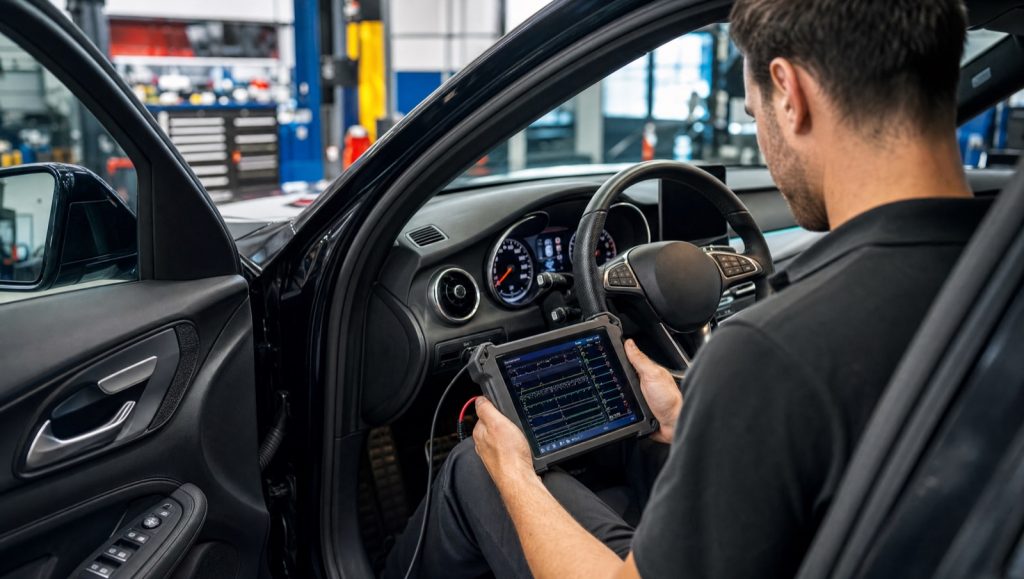
A warning light appears, and somebody offers to read the code for free. Twenty minutes later you have a five-character string, a printout, and a suggested part. Sometimes that works. On a European car, often enough to be a pattern, it produces a replaced component, a bill, and the same light back within a fortnight.
The gap between reading a code and diagnosing a fault is where the money is either saved or wasted. Here is what factory-grade equipment actually does that a generic reader cannot, and why we quote the diagnosis separately from the repair.
A code is a symptom, not a cause
Fault codes are written from the perspective of the module that noticed something. “System too lean, bank one” means the engine measured less fuel in the mixture than it expected. It does not say why.
The why could be an intake leak after the mass airflow sensor, a failing high pressure fuel pump, a blocked injector, a split PCV diaphragm, a faulty oxygen sensor reporting correctly on a real problem, or a faulty sensor lying about a healthy engine. Six causes, one code, and five of the six are not the part the code names.
Replacing on the code alone is how good parts end up in the bin. It is also why the same fault comes back: the sensor was reporting the truth, and nothing about the truth changed.
What manufacturer-level software reads that a generic tool does not
A generic OBD reader is legally required access to emissions-related engine data. That is the whole of it. On a modern European car it is a small fraction of what is there.
- Every module, not just the engine. Transmission, ABS, airbag, body, comfort, gateway, battery management, parking sensors, headlight levelling, infotainment. A fault in any of them can produce a symptom the driver blames on the engine.
- Freeze-frame data. What the car was doing at the exact moment the fault was stored: engine speed, load, coolant temperature, fuel trims, vehicle speed. That context often identifies the cause on its own.
- Live values while the engine runs. Watching a sensor respond in real time is how you tell a failing sensor from a genuine fault.
- Actuator tests. Commanding a component to operate and watching whether it does, rather than inferring from a code.
- Adaptations and basic settings. The learned values a car accumulates over years. Some repairs are not finished until these are reset, and some faults are nothing more than adaptations at the end of their range.
- Service functions. Retracting an electronic parking brake, registering a battery, bleeding an ABS unit, resetting a service counter properly.

The faults that never store a code at all
Diagnosis is not only about reading. A large share of what comes through the workshop never triggers anything.
A wheel bearing that hums at 80 km/h. A suspension bush that knocks over a speed hump. A gearbox that shudders pulling away from a standstill. A slow coolant loss with nothing on the driveway. Brake pads at two millimetres on a car whose wear sensor has not been reached yet. A parasitic drain flattening the battery every third night.
None of those produce a code, and all of them are real. Which is why a proper diagnosis starts with the car, the driver’s description and a road test, and uses the scan tool as one instrument among several rather than as the whole examination.
Why we charge for diagnosis, and why that is cheaper
Free code reading is a sales tool. It gets a car onto a hoist and produces a recommendation quickly, and speed is exactly what a difficult fault does not tolerate.
We quote the diagnosis and the repair separately. You pay for the time it takes to find the fault properly, you see what we found, and then you decide whether to have it repaired. That structure exists to protect you from the alternative: a workshop that guesses, fits a part, and bills you for the guess.
The arithmetic is straightforward. An hour of proper diagnosis against a mass airflow sensor, an oxygen sensor and an ignition coil fitted in sequence in the hope that one of them is the answer. The second approach is more expensive before it works, and it usually does not work.
What we need from you
Four details cut diagnostic time roughly in half, and they cost nothing to notice.
- When it happens. Cold start, after twenty minutes, at motorway speed, in stop-start traffic, only when it rains.
- What changed. Power, noise, smell, the gearbox, the idle, fuel consumption.
- Whether it clears itself and how often it returns.
- What was done recently. A service, a battery, an accessory fitted, a repair somewhere else. A surprising share of faults arrive with a recent job attached to them.
An intermittent fault that appears only after rain is a different search from one that appears only on a cold start, and knowing which stops the bill from growing.
Never let anyone just clear the codes
Clearing a fault turns the light off and destroys the evidence. The freeze-frame data goes with it, along with the count of how often the fault has occurred and the conditions in which it occurred.
If a workshop’s first move is to clear and hand the car back to “see if it comes back”, you have paid for a reset button. The light returns, usually at the worst moment, and the diagnosis starts from zero because the history is gone.
The intermittent fault, and how it is caught
The hardest cases are the ones that will not perform on command. A car that cuts out once a fortnight will not do it in a two-hour appointment.
Those are approached differently. The stored history is read for patterns. Live data is logged over a longer drive, sometimes with the car left with us for a day so a technician can drive it in the conditions the owner described. Wiring is tested with a meter rather than by looking at it, and voltage drop is measured across connections that appear fine. Where a fault is suspected in a specific circuit, that circuit is stressed deliberately.
It takes longer, we say so up front, and it is the only method that actually ends the problem. The detail of how we run it is on our diagnostics page.
Booking it in Artarmon
We are an independent European workshop, not a dealership, minutes from Chatswood, St Leonards and Crows Nest, working by appointment so a car with a difficult fault gets uninterrupted time rather than a slot between two services.
If the warning light is red, do not drive the car in, call us. If it is amber and the car is behaving, book it in the next few days. Everything we repair is backed by our 1 year / 10,000 km workshop guarantee, and the full list of what we do is on the Sydney services page.
Common questions
How we quote, and what happens if we find something
You see the quote before anything is touched. If we find something outside the schedule while the car is with us, you get a phone call with the finding, the options and the price, not a longer invoice at pickup.
Diagnosis and repair are quoted separately, because they are different work. You are told what we found whether or not you go ahead with the repair here.
Everything we carry out is backed by a twelve month or 10,000 km guarantee, and the parts and fluids used are recorded by number and specification on the invoice.
Booking in Artarmon
The workshop is at 1/39 Hotham Parade, Artarmon NSW 2064, minutes from Chatswood, Lane Cove, St Leonards and Crows Nest. We are appointment only, which means the technician who starts your car finishes it rather than moving between six jobs.
Send us the rego and the odometer, or a photo of the service screen in the car, and we will tell you exactly what is due before you commit to anything. If the car is not drivable, call 1300 136 825 and we will work out the fastest option.
You see the quote before anything is touched, nothing happens without your approval, and every job is backed by a twelve month or 10,000 km guarantee.
Somewhere else read the code for free. Why does yours cost money?
Because reading is not diagnosing. You are paying for the time to test the circuit and prove which component failed, which is what stops good parts being replaced for nothing.
Can you diagnose a fault that only happens occasionally?
Usually. The stored memory keeps a record even when the symptom is absent, and for the hard ones we log live data over a longer drive rather than guessing.
Will you tell me what it costs before doing the work?
Always. Diagnosis and repair are quoted separately, and nothing gets done until you approve it.
Do you have manufacturer-level access for every make you service?
For the European makes we specialise in, yes: every module, adaptations and service functions included. Ask about your specific model when you book.