
A light appears on the dash of your Audi. The question that follows is always the same: do I pull over, or do I finish the drive and deal with it later? Most owners guess, and the guess goes wrong in both directions. People limp home with an engine that should have been switched off, and people book emergency appointments for a light that means the washer bottle is low.
The rule is simpler than it looks, and knowing it saves both the panic and the damage.
Red means stop. Amber means investigate. Everything else is information
Audi, like every other European manufacturer, colours its warnings deliberately.
Red is a fault that can hurt you or destroy something expensive in minutes. Pull over when it is safe, switch the engine off, and call. Continuing to drive is what turns a repair into a replacement.
Amber or yellow means a system has reported a fault and the car has usually moved into a protective mode. It is not an emergency. It is also not something to sit on for three months, because the car has stopped optimising and started protecting itself.
Green, blue and white are status, not warnings. They tell you something is switched on.
The three that should end the drive immediately
Oil pressure. The red can with a drip. This is not the “check oil level” message, which is a different, softer warning. Red oil pressure means the pump is not delivering, and an engine running without oil pressure is destroying its bearings while you decide. Thirty seconds matters here. Switch off, do not restart to “just get it home”.
Coolant temperature. Red thermometer, or a temperature needle past the middle and climbing. On the 2.0 TFSI family the usual cause is a failed water pump or thermostat housing, and the usual consequence of continuing is a warped head. Pull over, let it cool, do not open the cap.
Brake system. A red brake warning, especially with a hard or long pedal, means fluid level or a hydraulic fault. The car may still stop. It may also not stop the second time.

The ambers that owners ignore for too long
Check engine. The most misunderstood light on the car. It covers everything from a loose fuel cap to a failing ignition coil, and the light itself tells you nothing about which. What matters is behaviour: a steady light on a car that drives normally is a fault to book in for. A flashing check engine light is a misfire dumping unburnt fuel into the catalytic converter, and that is a red-level problem wearing an amber colour. Reduce load and get it looked at that day.
EPC. The electronic power control light is specific to the VW and Audi family, and it means the throttle system has flagged a fault. The car will usually drop into reduced power. It is drivable, gently, to a workshop. It is not drivable for a fortnight.
DPF or exhaust emissions, on a TDI. The particulate filter has not been able to complete a regeneration. Sydney short trips cause this: the cycle needs sustained driving to finish, and a car doing school runs on the Lower North Shore never gets there. Caught early, a good drive can clear it. Caught late, the filter is a four-figure part.
Airbag. Nothing changes in how the car drives, which is exactly why people leave it. What it means is that at least one restraint system has taken itself offline, and it will not deploy in a crash.
Why the light is not the diagnosis
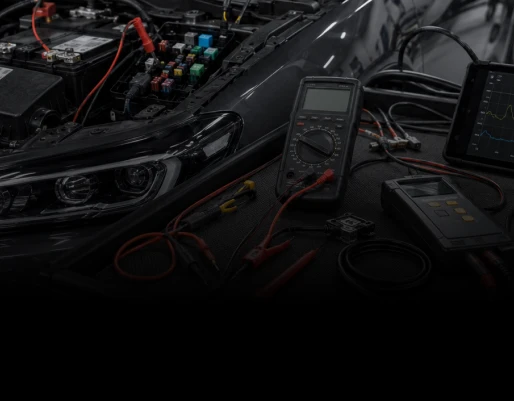
A warning light is a summary. Behind it sits a fault code, and behind the code sits the data that explains it.
A generic code reader gives you the code and stops there. That is how good parts get replaced for nothing: the code says “lean mixture”, so someone fits an oxygen sensor, and the light comes back a week later because the real cause was an intake leak the sensor was correctly reporting.
Manufacturer-level software talks to every module, not just the engine, reads freeze-frame data showing what the car was doing when the fault was stored, and shows live values while the engine runs. That is how you tell a failing sensor from the part it is blaming. There is more on how we run it on our diagnostics page.
The faults that never light anything at all
The reverse problem is more common than owners expect. Plenty of real faults never trigger a lamp.
A gearbox that shudders pulling away, a wheel bearing that hums at 80 km/h, a suspension bush that knocks over a speed hump, a slow coolant loss with nothing on the driveway, brake pads at two millimetres on a car whose wear sensor has not been reached yet. None of those produce a warning light, and all of them are on their way to becoming expensive.
This is why we read the full fault memory at every service, including stored intermittent faults that have not lit anything up. A code logged three times in the last month and cleared by the car itself is the next problem announcing itself early.
Do not let anyone just clear the code
Clearing a fault turns the light off. It does not fix anything, and it destroys the evidence: the freeze-frame data goes with it, along with the count of how often the fault has occurred.
If a workshop’s first move is to clear codes and hand the car back to “see if it comes back”, you have paid for a reset button. The light will return, usually at the least convenient moment, and the diagnosis starts from zero because the history is gone.
We quote the diagnosis and the repair separately for exactly this reason. You pay for the time it takes to find the fault, you see what we found, and then you decide whether to have it fixed. Nothing gets done without your approval.
What to tell us when you book
Four details cut the diagnostic time roughly in half, and they cost you nothing to notice.
- Colour of the light, and whether it is steady or flashing.
- What the car was doing when it appeared: cold start, motorway, stop-start traffic, after refuelling, after rain.
- Whether anything changed in how it drives: power, noise, smell, the gearbox.
- Whether it clears itself and comes back, and roughly how often.
An intermittent fault that appears only after rain is a completely different search from one that appears only on a cold start, and knowing which we are looking for is what stops the bill from growing.
Booking it in Artarmon
We are an independent European workshop, not a dealership, five minutes from Chatswood, St Leonards and Crows Nest, working by appointment so a car with an intermittent fault gets uninterrupted time rather than a slot between two services.
If the light is red, do not drive it in. Call and we will talk through it. If it is amber and the car is behaving, book it in the next few days rather than the next few months. Everything we repair is backed by our 1 year / 10,000 km workshop guarantee, and the full list of what we do is on the Sydney services page.
Common questions
How we quote, and what happens if we find something
You see the quote before anything is touched. If we find something outside the schedule while the car is with us, you get a phone call with the finding, the options and the price, not a longer invoice at pickup.
Diagnosis and repair are quoted separately, because they are different work. You are told what we found whether or not you go ahead with the repair here.
Everything we carry out is backed by a twelve month or 10,000 km guarantee, and the parts and fluids used are recorded by number and specification on the invoice.
Booking in Artarmon
The workshop is at 1/39 Hotham Parade, Artarmon NSW 2064, minutes from Chatswood, Lane Cove, St Leonards and Crows Nest. We are appointment only, which means the technician who starts your car finishes it rather than moving between six jobs.
Send us the rego and the odometer, or a photo of the service screen in the car, and we will tell you exactly what is due before you commit to anything. If the car is not drivable, call 1300 136 825 and we will work out the fastest option.
You see the quote before anything is touched, nothing happens without your approval, and every job is backed by a twelve month or 10,000 km guarantee.
The light went off by itself. Do I still need to book?
Yes. The fault is stored in memory even when the lamp clears, and a fault that comes and goes is usually an early stage of something that will eventually stay on.
Can I drive with the check engine light on?
If it is steady and the car drives normally, to a workshop yes. If it is flashing, that is a misfire damaging the catalytic converter, so reduce load and get it seen the same day.
Why does a diagnosis cost money if the code is free to read?
Because the code is the starting point, not the answer. You are paying for the time to test the circuit and prove which component actually failed, which is what stops good parts being replaced for nothing.
Do you work on Audis still under factory warranty?
Every week. Australian Consumer Law protects exactly that case, provided the schedule, the parts and the documentation are right, which is how we work anyway.