“Auto electrician near me” is one of the most searched phrases in Brisbane that has anything to do with cars, and almost every one of those searches starts the same way: something electrical stopped behaving, and the obvious suspect is the battery. Sometimes it is. On a European car, most of the time it is not, and replacing the battery buys you a few weeks before the same thing happens again.
This is what actually goes wrong, in the order we see it at our Albion workshop, and how a fault gets traced instead of guessed at.
Why the battery gets blamed for everything
A modern European car does not switch off when you take the key out. Dozens of control units stay awake for a while, then step down through sleep states over several minutes, and a handful stay reachable indefinitely so the car can respond to the remote, the alarm and the telematics module. That behaviour is normal and it is designed around a known, very small current draw once everything has settled.
When one module fails to go to sleep, that small draw becomes a large one, and the battery does the work of covering it every night. The owner experiences this as a car that starts slower each morning until one morning it does not start at all. The battery gets replaced. The module still does not sleep. Six weeks later the new battery is flat too.
The fix is not a bigger battery. It is finding the module that is staying awake, which is a measurement, not an opinion.
How a parasitic drain is actually found
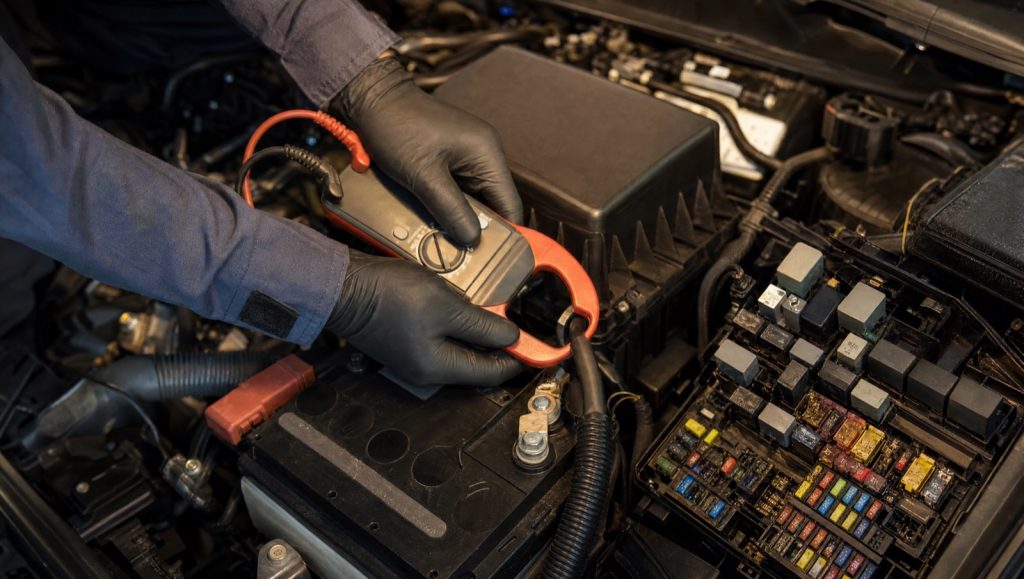
The test is simple to describe and takes patience to do properly. The car is locked and left to settle until every module has completed its sleep sequence, which on some makes takes upwards of half an hour. Then current draw is measured at the battery. If it is above the manufacturer’s figure, fuses come out one at a time until the number drops, and the circuit that caused the drop is the one to investigate.
That is the honest version. There is no shortcut where someone looks at the car and names the part. Anyone who does is guessing, and the guess is charged to you in replaced components that were never faulty.
The usual culprits, in the order we find them: an aftermarket accessory wired to a permanent live instead of a switched one, a boot or bonnet latch switch that thinks the lid is open, a comfort access or keyless entry module, an amplifier that stays powered, and a failing body control module. Dashcams and trackers installed by whoever sold the car are the single most common cause we see, and they are also the cheapest to fix.
Battery testing: state of charge is not state of health
Two different numbers get confused here, and the difference decides whether you need a battery at all.
State of charge is how full the battery is right now. It moves with use and recovers after a drive.
State of health is how much of its original capacity the battery can still hold. It only ever goes down, and it is what tells you whether the battery is genuinely finished.
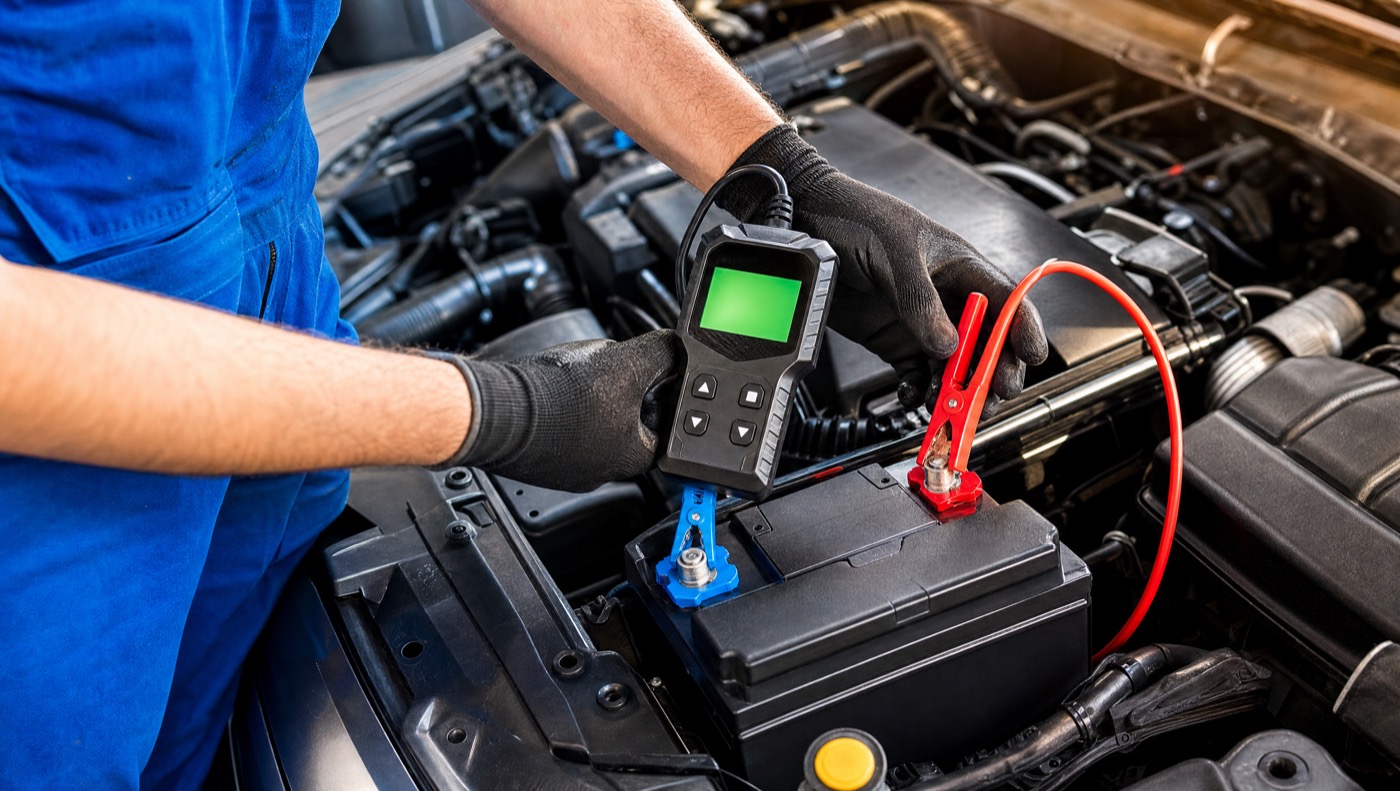
A battery that reads 12.6 volts at rest can still be at the end of its life, because voltage under no load tells you almost nothing about capacity under load. A proper test loads the battery and measures how it behaves, which is why we test at every service on cars that live around here.
Brisbane is genuinely harder on batteries than the cooler capitals. Sustained heat accelerates the chemistry that ages a battery, and a car that spends its days parked in the sun and its evenings doing short trips never gets a full recharge cycle. Four years is a good run here. Five is unusual.
Registering the new battery: the step that gets skipped
On most European cars built in the last fifteen years, fitting a battery is only half the job. The car runs a battery management strategy that adjusts charging voltage according to the battery’s age and type, and it needs to be told, through the diagnostic system, that a new battery has been fitted and what kind it is.
Skip that step and the car keeps charging as though the old, aged battery were still in place. The new one is undercharged, sulphates early, and fails a long way short of its expected life. It is one of the most common reasons a battery replaced somewhere cheap fails within two years, and it costs nothing to do correctly if the workshop has the software.
Fitting an AGM battery where the car expects one, and telling the car about it, is not an upsell. It is the specification.
When it is not the battery at all
Three other faults present as “electrical problems” and send people searching for an auto electrician.
The alternator or its regulator. Charging voltage that is too low leaves the battery permanently undercharged, and charging voltage that is too high cooks it. Both look like a battery problem from the driver’s seat. A charging system test takes minutes and settles it.
Earth and connection faults. Corroded or loose earth straps produce the strangest symptoms in the workshop: windows that operate slowly, lights that dim when another circuit is used, modules that report faults in each other. Brisbane humidity does not help. These are cheap fixes that look like expensive ones until someone measures voltage drop across the connection.
Water where it should not be. Blocked sunroof or scuttle drains send water into places that hold control modules, and the resulting corrosion produces intermittent faults that come and go with the weather. If your car misbehaves after rain and behaves after a dry week, say so when you book. It narrows the search enormously.
What we do, and what it costs you to find out
We quote the diagnosis and the repair separately. You pay for the time it takes to find the fault, you see what we found, and then you decide whether to have it fixed. Nothing gets done without your approval, and we do not replace parts on suspicion.
That approach exists because electrical work is where guesswork does the most damage to a bill. A battery, an alternator and a body control module fitted one after another in the hope that one of them is the answer is a four-figure invoice for a fault that a properly conducted drain test would have found in an hour.
If any of the symptoms above sound like your car, the detail of what we cover is on the auto electrical page, and if the fault is showing up as a warning light rather than a flat battery, the diagnostics page is the better starting point. Everything we carry out is backed by our 1 year / 10,000 km workshop guarantee.
We are an independent European workshop in Albion, minutes from Ascot, Hamilton and Newstead, and we work by appointment so a car with an intermittent fault gets the uninterrupted time it needs rather than a slot between two services.
Common questions
Why we measure instead of estimating
Almost every recommendation we make comes with a number attached. Brake pad and disc thickness in millimetres against the manufacturer minimum, tyre tread by corner with the wear pattern noted, battery state of health, and coolant strength.
That matters because a pad at 5 mm and a pad at 3 mm both look fine through a wheel and mean completely different things for your next six months. With the number in front of you, you can decide whether to act now or at the next service instead of taking a verdict on trust.
It is also what lets us tell you honestly that something can wait. A workshop that never says that is not measuring.
Booking in Albion
The workshop is at 21 Pedder St, Albion QLD 4010, minutes from Hamilton, Teneriffe, Newstead, Ascot and Clayfield. We are appointment only, which means the technician who starts your car finishes it rather than moving between six jobs.
Send us the rego and the odometer, or a photo of the service screen in the car, and we will tell you exactly what is due before you commit to anything. If the car is not drivable, call 1300 093 121 and we will work out the fastest option.
You see the quote before anything is touched, nothing happens without your approval, and every job is backed by a twelve month or 10,000 km guarantee.
Parts, fluids and the approval that matters
We fit genuine OEM parts by default and use oil carrying the manufacturer approval for your engine rather than simply the right viscosity. The approval governs additive chemistry, ash content and shear stability, which is what decides how long a particulate filter or a timing chain lasts.
Where a quality equivalent makes sense for a specific job we explain the difference and let you choose rather than deciding for you.
Every part number and fluid specification is recorded on the invoice, which is what makes the service history hold up later.