
Typing “mechanic near me” into your phone in Artarmon returns a list of workshops sorted by how close they are and how many reviews they have. Neither of those tells you whether the person who opens your bonnet has worked on your car before. Here is what actually separates one workshop from another, and the questions worth asking before you hand over the keys.
We are an independent European specialist five minutes from Chatswood, St Leonards and Crows Nest, so we are one of the results in that list. The advice below applies whether you end up with us or not.
Proximity is the worst reason to choose a workshop
A car service is not a coffee. You drop the car in the morning and collect it in the afternoon, which means the extra six minutes of driving costs you nothing, while the wrong workshop can cost you a gearbox. The distance that matters is the distance you can walk to a train, not the distance from your front door to the roller door.
Artarmon sits on the Lower North Shore line, which is exactly why it works: drop the car, walk to the station, be in the city in twenty minutes. That is the number worth optimising, not the kilometres.
Six questions worth asking on the phone
- Have you worked on this model before? Not the brand, the model. A workshop that services Golfs every week is not automatically comfortable with a Touareg air suspension.
- What diagnostic equipment do you use for my car? A generic OBD reader pulls a code. Manufacturer-level software talks to every module, runs adaptations and codes new parts. On a European car, the difference decides whether a fault is found or guessed at.
- Do you quote before starting? The answer should be yes, without hesitation, and the quote should be itemised.
- What parts do you use? Genuine, OE or aftermarket, and why for this particular job.
- Do you record the service digitally? Most European brands stopped using paper stamps. If nobody writes the service against your VIN, it did not happen as far as the next buyer is concerned.
- What warranty do you give on the work? Ours is one year or 10,000 km, on parts and labour.
You will learn more from those six answers than from fifty reviews.
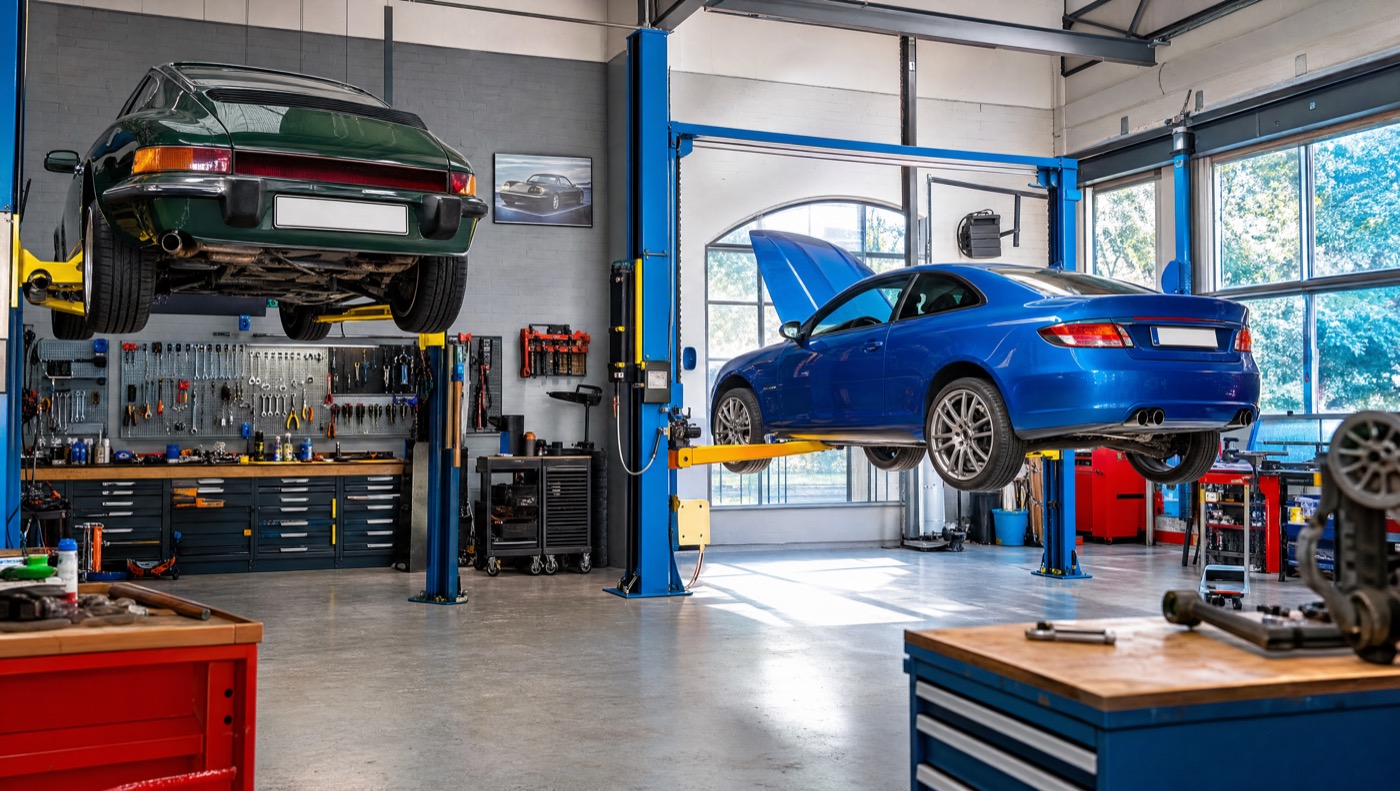
What “European specialist” should mean
The phrase is not protected, so anyone can print it on a sign. In practice it should mean four things: manufacturer-level diagnostic software rather than a generic scanner, technicians trained on those brands, access to genuine and OE parts through proper channels, and enough volume in those makes that the common faults are recognised on sight rather than diagnosed from scratch.
That last one is underrated. A workshop that sees twenty BMWs a week knows the noise a failing valvetronic motor makes before it plugs anything in. That knowledge is not in a manual, and it is what shortens a diagnosis from three hours to twenty minutes.
The signs of a workshop worth keeping
You can tell a lot on the first visit, before any spanner comes out:
- They ask what the car is doing, not just what you want done. A good intake question is “when does it happen, cold or hot, and how long has it been like that”.
- They call you before doing extra work, with the reason and the price.
- They show you the old part, or a photo of it, without being asked.
- The invoice lists parts by number and fluids by specification.
- They tell you what can wait. A workshop that finds five urgent jobs on every car is selling, not diagnosing.
What a general workshop does well, and where it stops
None of this means a general mechanic is bad. For a Corolla, a competent general workshop is the sensible choice and usually the cheaper one. The line gets crossed on European cars in three places.
The first is electronics. A modern European car runs dozens of control modules that talk to each other, and replacing a part often requires coding it to the car. Without the right software, a perfectly good new part sits there doing nothing.
The second is fluid and parts specification. European manufacturers approve specific oils, coolants and transmission fluids by name, not by viscosity alone. “Close enough” shortens the life of the component it is meant to protect.
The third is knowing the failure patterns. Timing chain guides on certain engines, plastic thermostat housings, mechatronic sleeves, air suspension compressors. Somebody who sees these weekly quotes the job accurately. Somebody who does not will discover the real problem halfway through.
Booking, dropping off and getting the car back
Most weeks we have same-week availability. Drop-off starts at 7am, which exists because people need to get to work, and there is a late or after-hours key drop for the days when the morning falls apart. Book online in about two minutes and we confirm the time within one business day, usually with a quick call.
If the car is not driveable, tell us when you book. It changes how we schedule the day and saves you a tow you might not need.
Common questions
What to look for when you walk in
A workshop tells you a lot before anyone speaks. Look at the cars in the bays: if they are the same makes as yours, the technicians see your problems every week rather than occasionally. Look at the equipment: a factory-level diagnostic system on a stand, a proper hoist in every bay, torque wrenches in use rather than on a shelf.
Then look at the paperwork on the counter. Workshops that measure things write numbers down, and if the previous customer’s report shows pad thickness in millimetres and tread by corner, yours will too.
None of that requires you to know anything technical. It only requires you to notice whether the place is set up to be precise.
The six questions worth asking
Which diagnostic system do you use for my make, and does it read every module or only the engine. Can you code and adapt components, because fitting a part is only half the job on a modern European car. Is ADAS calibration done here or sent out, because that decides whether you get the car back the same day.
What oil will you use, and does it meet the manufacturer approval for my engine. What happens if you find something extra mid-job. And what do you guarantee on the work.
A workshop that answers those six clearly is reading your car’s schedule. One that deflects is working from a generic table.
Why we measure instead of estimating
Almost every recommendation we make comes with a number attached. Brake pad and disc thickness in millimetres against the manufacturer minimum, tyre tread by corner with the wear pattern noted, battery state of health, and coolant strength.
That matters because a pad at 5 mm and a pad at 3 mm both look fine through a wheel and mean completely different things for your next six months. With the number in front of you, you can decide whether to act now or at the next service instead of taking a verdict on trust.
It is also what lets us tell you honestly that something can wait. A workshop that never says that is not measuring.
Booking in Artarmon
The workshop is at 1/39 Hotham Parade, Artarmon NSW 2064, minutes from Chatswood, Lane Cove, St Leonards and Crows Nest. We are appointment only, which means the technician who starts your car finishes it rather than moving between six jobs.
Send us the rego and the odometer, or a photo of the service screen in the car, and we will tell you exactly what is due before you commit to anything. If the car is not drivable, call 1300 136 825 and we will work out the fastest option.
You see the quote before anything is touched, nothing happens without your approval, and every job is backed by a twelve month or 10,000 km guarantee.
How we quote, and what happens if we find something
You see the quote before anything is touched. If we find something outside the schedule while the car is with us, you get a phone call with the finding, the options and the price, not a longer invoice at pickup.
Diagnosis and repair are quoted separately, because they are different work. You are told what we found whether or not you go ahead with the repair here.
Everything we carry out is backed by a twelve month or 10,000 km guarantee, and the parts and fluids used are recorded by number and specification on the invoice.
Do I need an appointment or can I just turn up?
By appointment. It is the only way every car gets a specialist’s full attention instead of being squeezed between two other jobs.
Can you look at it while I wait?
For a quick check, sometimes. For a diagnosis or a service, no, and any workshop that says yes to everything is not being straight with you.
Do you work on cars that are not European?
We do, and we say so when the job is better handled elsewhere. Our equipment and our parts channels are built around European makes.