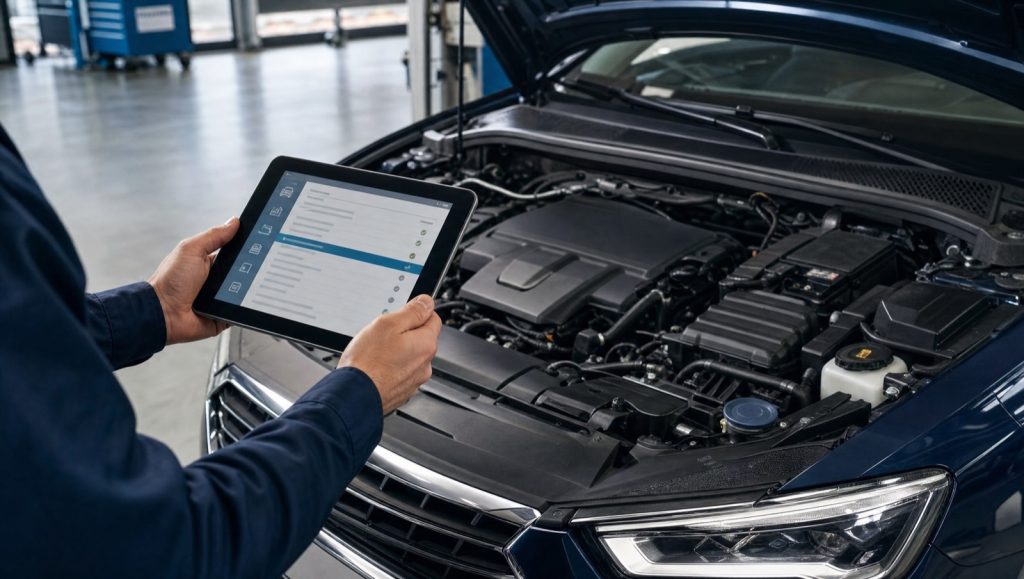
If your BMW is due for a logbook service in Artarmon and you are weighing up the dealership against an independent workshop, the short answer is this: the logbook does not care where the work happens. It cares that the right operations are carried out, at the right interval, with the right parts, and that someone writes it down properly. That is the whole test.
We service BMWs every week at our Artarmon workshop, and the same three questions come up on the phone: what does the car actually need right now, what does the dealership do that we do not, and will the warranty survive. Here is the honest version of each.
BMW does not use a fixed kilometre interval any more
Most owners still think in terms of “every 10,000 km”. Modern BMWs do not work that way. Since the mid-2000s the car has used Condition Based Servicing, or CBS: sensors and counters track engine oil quality, brake pad wear, brake fluid age, cabin filter hours, spark plug life and the annual vehicle check, and each item has its own countdown.
That is why two identical 3 Series can be due for completely different work at the same odometer reading. A car that spends its life crawling between Chatswood and the city, with short trips and long idles, will burn through its oil counter far quicker than one that does a weekly run up the M1. The counter is measuring how hard the oil has worked, not how far the wheels have turned.
In practice, most petrol BMWs in Sydney land on an oil service somewhere between 12,000 and 15,000 km, or every 12 months, whichever comes first. The 12 month part is the one people forget. Oil degrades with time and moisture, not only with distance, and a low-kilometre car that sits in a garage in Artarmon through a humid summer still needs its oil changed on schedule.
What is actually done at an oil service
An oil service is the most common visit, and it should never be just draining and refilling. On a BMW it means:
- Engine oil drained hot, the sump plug sealing washer replaced, and the correct grade refilled to the exact quantity for that engine.
- A new oil filter element and its o-rings, not a wipe and reuse.
- The CBS counter reset properly through the diagnostic system, so the car knows the work was done.
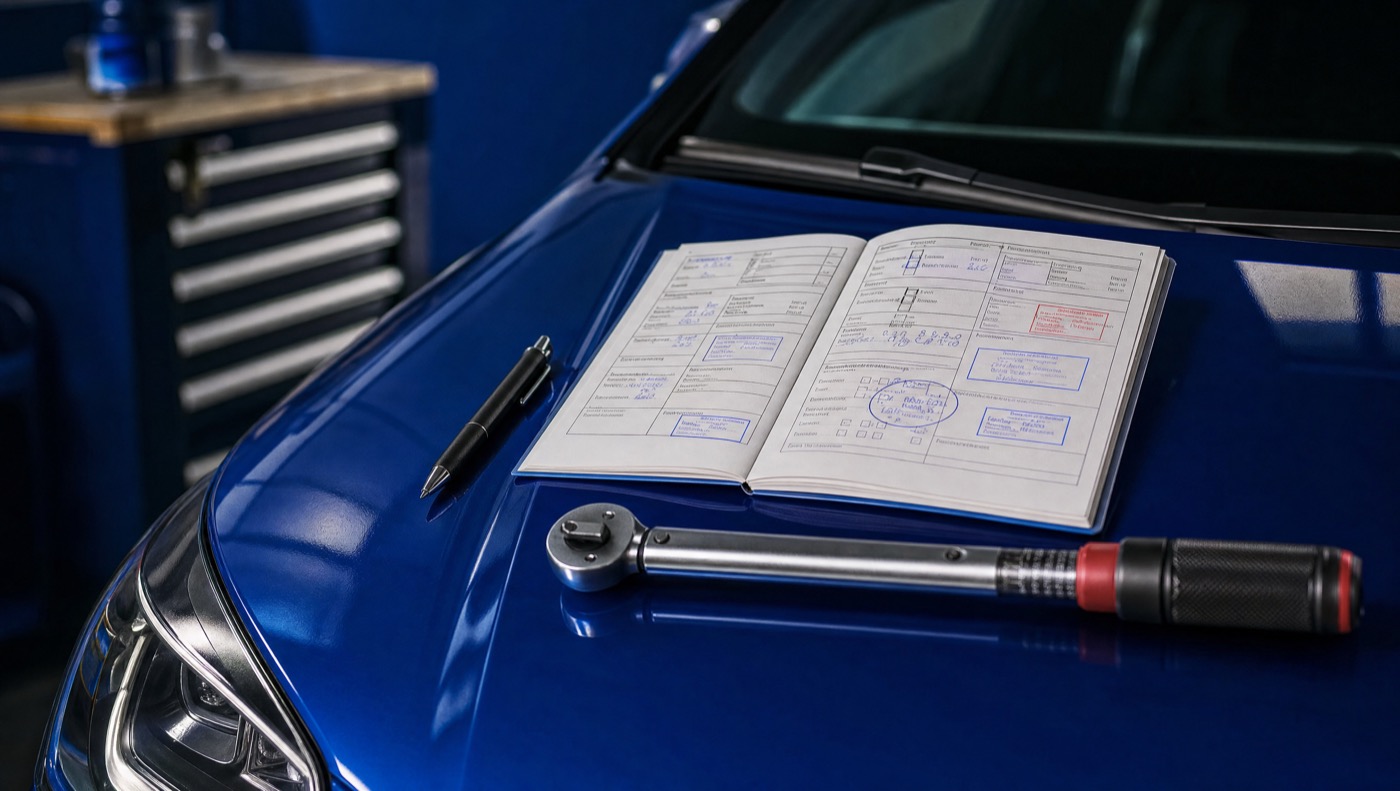
- A digital record of the service written against the vehicle, which is what replaces the stamp in the old paper book.
The grade matters more on these engines than on almost anything else we work on. BMW specifies Longlife oils to a particular approval, and the difference is not marketing. The wrong viscosity in a turbocharged N20 or B48 affects how quickly oil reaches the turbo bearings on a cold start, and cold starts are exactly what a Lower North Shore commute is made of.
What changes at a vehicle check
The annual vehicle check is the visit where a workshop earns its keep. It is not a quick look around. On a BMW it covers the brake system down to pad thickness and disc condition, the suspension and steering joints, the exhaust and underbody, all fluid levels and conditions, the cooling system, the battery state of health, tyre wear patterns and the full electronic fault memory across every module.
That last one is where most of the useful information hides. A car can drive perfectly and still be storing intermittent faults: a lazy oxygen sensor, an occasional misfire counter climbing on one cylinder, a valvetronic motor drawing more current than it should. None of those will light the dashboard yet. All of them are cheaper to deal with now than in six months.
The warranty question, answered properly
This is the one that keeps people paying dealer prices out of fear, so let us be specific.
Under Australian Consumer Law, a manufacturer cannot void your warranty simply because the car was serviced by an independent workshop. The Australian Competition and Consumer Commission has been explicit about this: telling a consumer that they must return to the dealership to keep their warranty is misleading. What the manufacturer can require is that the servicing was carried out to their schedule, using parts that meet their specification, by someone qualified to do it.
So the warranty survives on three conditions, all of which are in your control:
- The correct service is done at the correct interval, not late.
- The parts and fluids meet BMW specification, which is why we use genuine or OE parts rather than the cheapest equivalent.
- There is a written record with date, kilometres, parts used and what was carried out.
If a warranty claim is ever refused, the manufacturer has to show that the independent service caused the failure. A properly documented service history makes that argument very difficult to run.
Genuine, OE or aftermarket
These three words get used as if they mean the same thing. They do not.
Genuine parts come in a BMW box, from BMW. OE parts are made by the same manufacturer that supplies BMW’s production line, in their own box, often at a lower price for the identical component. Aftermarket parts are made by somebody else entirely, and quality ranges from excellent to genuinely unsafe.
We work with genuine and OE. On some items, like brake friction material and cooling system plastics, the difference between OE and cheap aftermarket shows up within a year in Sydney conditions. On others there is no meaningful difference and we will tell you so rather than pretend otherwise.
Signs you should not wait for the service light
The CBS counter is good at tracking wear items on a predictable curve. It is not good at telling you that something has started going wrong. Book earlier than scheduled if you notice:
- Oil level dropping between services, especially on turbocharged four cylinders.
- A sweet smell after a drive, which usually means coolant is escaping somewhere warm.
- Steering that has developed a knock over the speed humps around Artarmon and Naremburn.
- A cold start that sounds rougher than usual for the first few seconds.
- The car sitting lower on one corner overnight, on models with air suspension.
None of these are emergencies on the day. All of them get more expensive the longer they run.
Two BMW jobs that look simple and are not
Batteries. A BMW does not just take a new battery, it has to be told about it. The intelligent battery sensor adjusts the charging strategy to the age of the battery it thinks is fitted, and an unregistered new battery gets charged like an old one. The result is a battery that fails early and electrical faults that look like everything except a battery. Registration takes minutes with the right software and is part of every battery job we do.
Rear brakes. Most current BMWs have an electronic parking brake, which means the rear caliper pistons are driven by a motor. Before the pads come off, the system has to be put into service mode through the diagnostic software. Wound back by hand, the actuator is damaged, and a routine brake job turns into a part nobody budgeted for.
Independent, not the dealership
We are an independent workshop, not a dealership, and that shapes how the job runs. You speak to the person who worked on your car, not to a service adviser reading from a screen. We quote before we touch anything, and if we find something extra we call you with the evidence rather than adding it to the invoice. Every service carries our own one year or 10,000 km guarantee, on top of whatever factory warranty the car still has.
The practical differences show up in the details. A service menu is built to be the same for every car; we look at what your car has actually done since the last visit and quote that. We use manufacturer-level diagnostic access to reset the CBS counters and write the service against the VIN, so the record looks exactly like any other entry in the car’s history. And ADAS calibration, which modern BMWs need after a windscreen, alignment or suspension job, is done in-house rather than sent out, so the car comes back from one place, finished.
We are five minutes from Chatswood, St Leonards and Crows Nest, with easy parking, which matters more than it sounds when you are dropping a car before work.
Booking a BMW service in Artarmon
The workshop is at 1/39 Hotham Parade, Artarmon NSW 2064, open Monday to Friday from 7am to 5:30pm. Tell us the model and engine when you book and, if you can, send a photo of the service screen so we know which CBS items are due before the car arrives. You can book through our BMW booking page in about two minutes, or call 1300 136 825.
Common questions
Can I stretch the interval if I barely drive the car?
No. The 12 month rule exists because oil degrades with time. A garage-kept car with 4,000 km on the counter still needs its annual service.
Will you reset the service indicator?
Yes. The CBS counters are reset through the diagnostic system as part of the job, and the work is recorded digitally against your VIN.
Do you service BMWs still under factory warranty?
Every week. That is exactly the case the Australian Consumer Law protects, provided the schedule, the parts and the paperwork are right, which is how we work anyway.
How long does it take?
An oil service is usually a half day. A full vehicle check with brakes is normally a full day, and we will tell you before you leave the car, not after.
Do you use genuine BMW parts?
Genuine or OE, chosen for the job, with the part numbers on the invoice. Where there is no meaningful difference between the two, we say so.