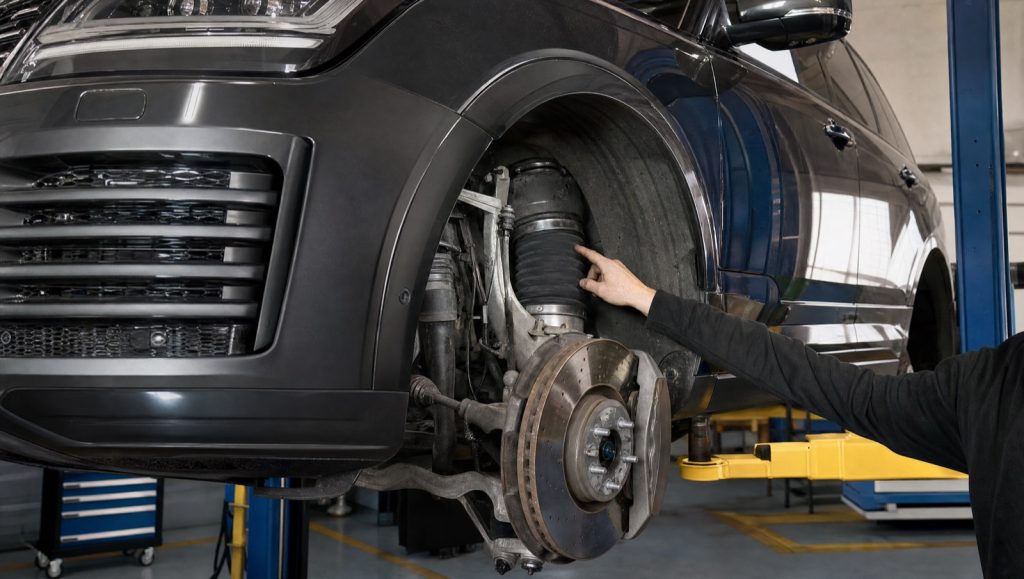
Air suspension is the part of a Range Rover that owners love until the morning it decides to sit on its bump stops in the driveway. What makes it worth understanding is that the failure almost never arrives without warning. It announces itself months in advance, quietly, in ways that are easy to explain away, and the cost of the repair roughly doubles between the first symptom and the last.
Here is the sequence, what each stage actually costs to fix, and where the point of no return sits.
What the system is doing
Instead of a steel spring at each corner, the car carries an air bag: a rubber and fabric bladder that holds pressurised air. A compressor fills them, a valve block distributes air between corners and a reservoir, and height sensors at each wheel tell the module how the car is sitting.
The module is constantly correcting. Load a boot full of luggage and it lifts the rear. Park on a slope and it levels. Drive at speed and it lowers the car for stability. That constant activity is the point of the system, and it is also why a small leak stays invisible for so long: the compressor simply works harder and the car stays level.
Stage one: the car is low in the morning
This is the first honest symptom, and the cheapest place to intervene.
You come out to the car after it has been parked overnight and it is sitting lower than usual, on one corner or across an axle. Start it, wait thirty seconds, and it lifts back to normal. Everything feels fine, so the owner files it under quirks.
What it means is that air is escaping somewhere while the car sleeps. Usually a bag that has developed a porous patch, sometimes a valve block seal, occasionally a line fitting. At this stage the repair is the leaking component, and the rest of the system is undamaged.
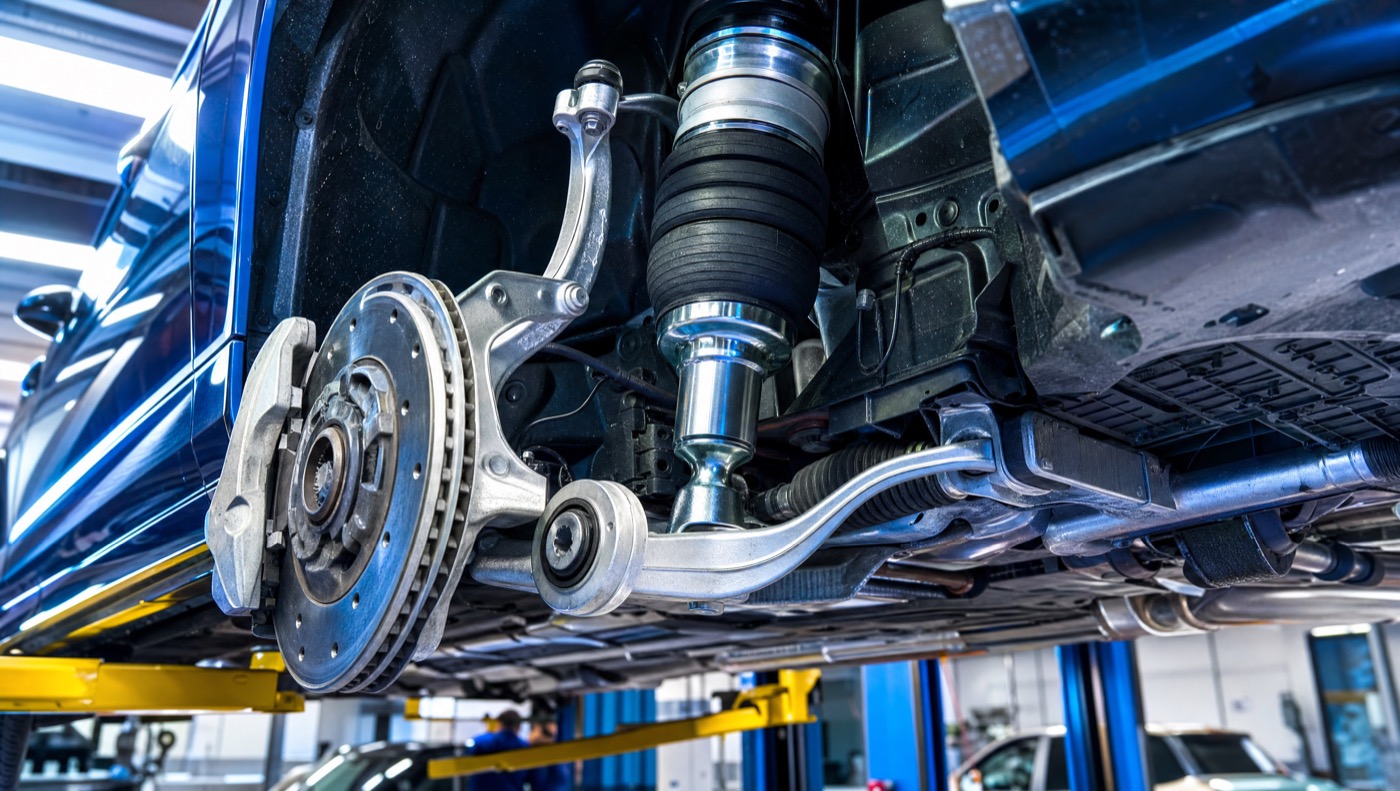
Stage two: the compressor is working overtime
The system compensates for the leak by running the compressor more often, and for longer.
You will hear it: a whirring from under the car after start-up that lasts longer than it used to, or that runs when the car is stationary. Compressors are designed for duty cycles measured in seconds, not minutes, and they are air-cooled by their own housing. A compressor covering a leak overheats, and heat kills the piston seal and, on many units, the dryer.
Fix the leak here and you may still save the compressor. This is the point where the bill can go either way.
Stage three: the dryer is saturated
Every air suspension system has a desiccant dryer that removes moisture from the air before it goes into the bags. It has a working life based on how much air passes through it.
A compressor running three times its normal duty pushes three times the air through the dryer, and when the desiccant saturates, moisture starts travelling into the system. Moisture corrodes valve blocks from the inside, freezes in cold snaps, and destroys the rubber it sits against.
At this point the repair list has grown from one bag to a bag, a compressor and a dryer, and the valve block is now a question mark rather than a certainty.
Stage four: the car will not lift
The warning appears, the car settles onto its bump stops, and it either refuses to raise or lifts and drops again. Now you are looking at the whole system, and often a tow, because driving a Range Rover on its stops damages driveshafts and CV boots.
The gap between stage one and stage four is often less than a year, and the difference in cost is not subtle.
How the fault is actually diagnosed
The important thing is that “air suspension fault” is not a diagnosis. There are four or five distinct components in that system and they fail differently.
What we do: read the module for stored faults and, more usefully, for the compressor run-time data, which the car records. Then the system is pressurised and each corner tested for hold, with the height sensor values watched live to see which corner is dropping and how fast. A leak detection fluid finds the porous patch on a bag; a corner that holds pressure while the neighbouring one drops points at the valve block rather than the bag.
That is a couple of hours of work, and it is what prevents the common alternative: four new bags fitted on the assumption that they were all tired, when one bag and a valve block seal was the actual fault. Our approach to that is on the suspension page: the diagnosis is quoted separately, and you see the evidence before anything is replaced.
Why Sydney is hard on these systems
Three local factors, none of them dramatic on their own.
Heat. A compressor lives in a hot engine bay, and a Sydney summer plus a duty cycle covering a small leak is a shorter life than the same car in a cooler climate.
Speed humps and driveways. The Lower North Shore is full of both. Every ramp compresses the bags to their limit, and cars that are lowered at speed have less travel to give.
Short trips. A car that runs for eight minutes never fully cycles the system or dries the dryer, and a car that sits for a week bleeds down and starts each session with the compressor working from zero.
None of this means the system is unreliable. It means the maintenance window is shorter here than the brochure assumed.
What we look at while it is on the hoist
An air suspension job is a good moment to check the parts around it, because they wear on the same roads.
Bushes and drop links, which produce the knock owners often blame on the air system. Height sensor linkages, which are plastic and break. Wiring at the sensors, which lives in the wheel arch and takes everything the road throws at it. And the ride height calibration itself, because a car that has had a sensor replaced without recalibration will sit wrong and wear tyres unevenly for years.
Should the system be converted to steel springs?
The conversion kits exist, and they are cheaper than a full system repair. Our honest view: for most owners, no.
You lose ride height adjustment, load levelling and the ride quality that is a large part of what you paid for. On many models the module continues to report a fault, and resale value takes a real hit because the next buyer knows exactly what has been removed. It can be the right answer on a very old, high-kilometre car being kept for utility, and we will say so if that is your situation. It is rarely the right answer on a car you intend to keep or sell well.
Booking it in Artarmon
We are an independent European workshop, not a dealership, minutes from Chatswood, St Leonards and Crows Nest. If your car is sitting low overnight, if the compressor is running longer than it used to, or if a warning has appeared, tell us which when you book and we will plan the time accordingly.
Diagnosis and repair are quoted separately, nothing is replaced on suspicion, and everything we fit is backed by our 1 year / 10,000 km workshop guarantee. The full list of what we do is on the Sydney services page.
Common questions
How we quote, and what happens if we find something
You see the quote before anything is touched. If we find something outside the schedule while the car is with us, you get a phone call with the finding, the options and the price, not a longer invoice at pickup.
Diagnosis and repair are quoted separately, because they are different work. You are told what we found whether or not you go ahead with the repair here.
Everything we carry out is backed by a twelve month or 10,000 km guarantee, and the parts and fluids used are recorded by number and specification on the invoice.
Booking in Artarmon
The workshop is at 1/39 Hotham Parade, Artarmon NSW 2064, minutes from Chatswood, Lane Cove, St Leonards and Crows Nest. We are appointment only, which means the technician who starts your car finishes it rather than moving between six jobs.
Send us the rego and the odometer, or a photo of the service screen in the car, and we will tell you exactly what is due before you commit to anything. If the car is not drivable, call 1300 136 825 and we will work out the fastest option.
You see the quote before anything is touched, nothing happens without your approval, and every job is backed by a twelve month or 10,000 km guarantee.
My car sits low overnight but lifts fine. Can I leave it?
You can, and the repair will grow while you do. That symptom is a leak the compressor is covering, and the compressor is the expensive part it takes with it.
Do all four bags need replacing at once?
Not necessarily. We test each corner and show you which is leaking. Replacing all four by default is common practice elsewhere and it is often more than the car needs.
Is it safe to drive a car that has dropped?
Not far. Driving on the bump stops damages driveshafts and CV boots and the handling changes considerably. Call us rather than driving it in.
How long does the work take?
Diagnosis is usually a couple of hours. A single bag with recalibration is normally a day. We tell you what we found before any repair starts.