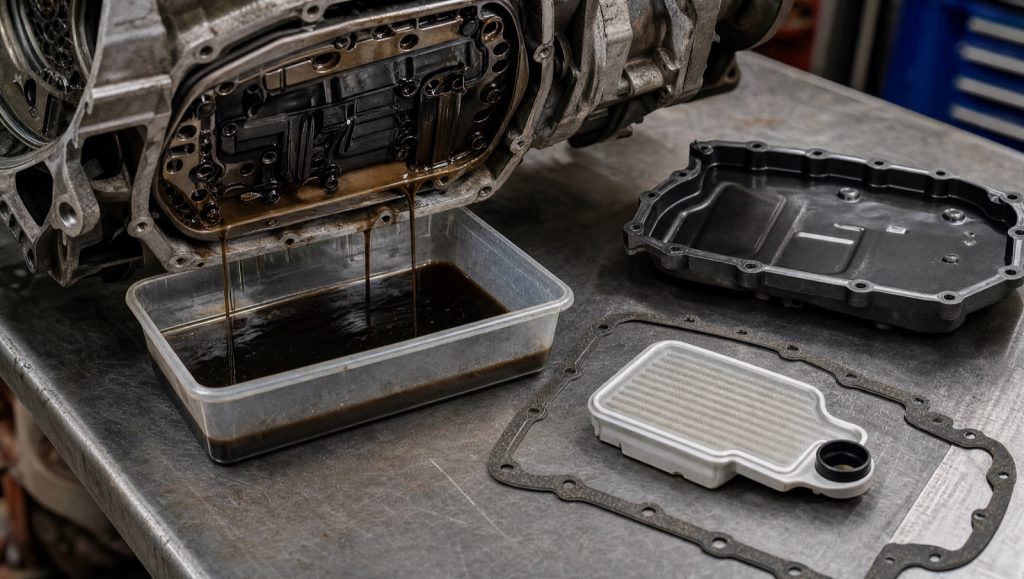
There is one line item that separates a Volkswagen that runs to 300,000 km from one that needs a gearbox at 120,000, and most owners have never been told it exists. It is the DSG service: fluid and filter on the dual-clutch transmission, due at roughly 60,000 km on the wet-clutch units.
It is not in the part of the logbook people read. It does not trigger a warning light when it is overdue. And on a car bought second-hand, it is almost never in the history. Here is what it actually is, what happens when it is skipped, and how to tell where your car sits.
What a DSG actually is, in one paragraph
A DSG is two gearboxes in one housing, each with its own clutch. One holds the odd gears, the other the even ones. While you are in third, the box has already pre-selected fourth, so the change is a handover between two clutches rather than a pause. That is why it shifts faster than you can and why it feels like an automatic without the slush of a torque converter.
The clever part is also the fragile part. Everything is managed by a mechatronic unit: a control module and hydraulic valve body living inside the transmission, bathed in the same fluid as the clutches. Fluid condition is not a maintenance detail on these boxes. It is the operating environment of the computer that runs them.
Wet or dry, and why it changes the interval
Volkswagen uses two families. The wet-clutch units, six and seven speed, run the clutch packs in oil and carry the fluid and filter service at around 60,000 km. The dry-clutch seven speed uses a much smaller amount of fluid for the mechatronics only, and its schedule is different.
If you do not know which one is in your car, we can tell you in a minute from the VIN. What you should not do is assume you have the “sealed for life” kind because nobody has ever mentioned a service. Most of the Golfs, Tiguans, Passats and Amaroks we see in Artarmon are wet-clutch, and most of them arrive with the fluid never having been changed.
What the service includes
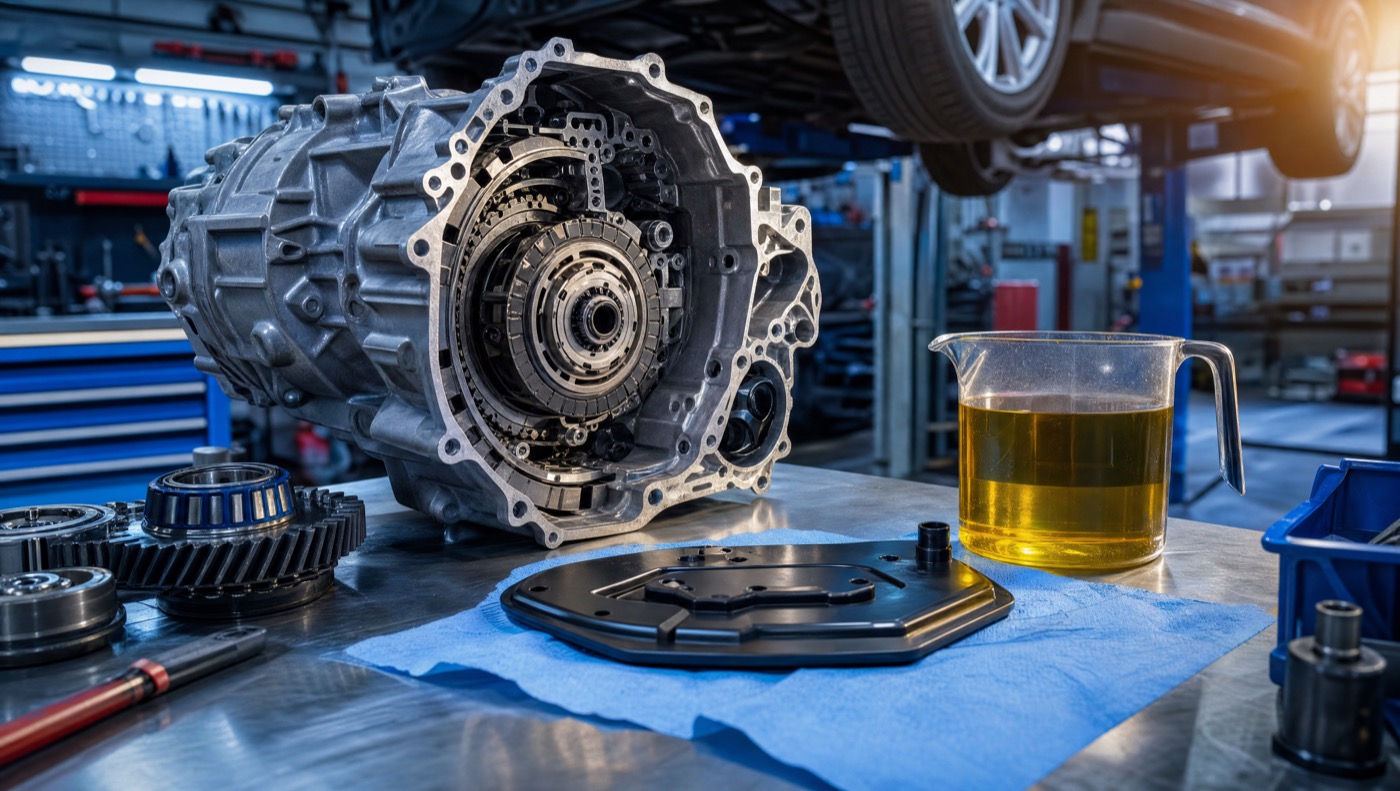
- Old fluid drained, and the quantity checked against what should have come out.
- The filter replaced. It is not a rinse-and-refit item, and skipping it is how debris ends up back in the valve body.
- New sump gasket and plug seals.
- Refill with the exact VW-approved fluid for that box, to a specification measured at temperature, not by eye.
- Adaptation values reset through the diagnostic system, so the box relearns clutch engagement points with clean fluid.
That last step is the one most often skipped by workshops without the software, and it matters. A DSG that has been compensating for degraded fluid for years holds adaptation values that no longer make sense once the fluid is new. Left alone, the car can shift worse after a service than before it, which is where the myth that “changing the fluid breaks them” comes from.
The symptoms, in the order they arrive
A DSG that needs attention does not fail suddenly. It tells you, in a sequence we see over and over.
First, a hesitation pulling away. You lift off the brake at a set of lights and there is a beat before the car moves. Owners adapt to this without noticing.
Then a shudder between first and second under light throttle, most obvious in slow traffic and on driveways with a slope.
Then a jerk on downshifts as you slow, particularly the 2-1 change coming to a stop.
Then a warning light or a limp mode, sometimes with the car refusing anything above third.
The cheap version of this repair lives in the first two stages. By the fourth, the conversation is usually about a mechatronic unit or clutch pack, and the number changes by an order of magnitude. Detail on how we handle it is on our transmission page.
Why Sydney traffic makes it worse
A DSG is happiest doing what it was designed for: moving, at a steady speed, with the clutches either fully engaged or fully open.
What it gets on the Lower North Shore is the opposite. Stop-start on the Pacific Highway means the low-speed clutch is slipping repeatedly rather than locking, and slipping generates heat. Heat degrades fluid. Degraded fluid stops cooling and lubricating the clutch pack properly, which generates more heat. Add a hill start on a Crows Nest driveway and a summer where the ambient temperature does not help, and a box on a 60,000 km schedule is doing more work per kilometre than the schedule assumes.
Owners who tow, or who do a lot of short trips with a full car, sit in the same category. None of this means the box is fragile. It means the interval is a maximum, not a target.
How to find out where your car stands
Three ways, in order of reliability.
Read the car. Modern VWs record service events internally against the VIN. If a DSG service was done properly, there is usually a trace. It takes minutes to check.
Look at the fluid. Fresh DSG fluid is clear. Fluid that has done 100,000 km is dark and smells burnt, and the sump often has a layer of clutch material at the bottom that tells its own story.
Read the adaptation data. The box keeps its own record of clutch engagement points and how far it has had to compensate. Values near the end of their range tell you the clutches are worn regardless of what any invoice says.
What we do not rely on is the folder of receipts, because a “transmission flush” on an invoice is often not this job at all.
What it is worth in money terms
A fluid and filter service is a planned, quotable job with a known cost. A mechatronic unit is a four-figure part before labour, and a clutch pack is the same conversation. The gap between them is the entire argument for doing this on schedule.
There is also resale. When you sell a Golf or a Tiguan in Sydney, a buyer who knows these cars will ask when the DSG was last serviced. A dated invoice with the part numbers on it is worth real money against a shrug, and it is exactly the sort of thing an inspector looks for during a pre-purchase check.
Independent, not the dealership
A DSG service is a job where the equipment matters as much as the spanners. Draining and refilling is the easy part. Filling to the right level at the right temperature, and resetting the adaptations afterwards, both need manufacturer-level diagnostic access, and that is exactly where many general workshops stop.
We do the full procedure, with the VW-approved fluid and a new filter, and the event is written against the VIN so it appears in the car’s own history. Because we are an independent workshop rather than the dealership, the quote comes before the work, and if the fluid or the adaptation data tells us the box needs more than a service, you hear it from the technician with the evidence in front of you.
The same applies to the Audi models that use the same dual-clutch transmissions under the S tronic name, and the service is covered by our 1 year / 10,000 km workshop guarantee.
Booking it in Artarmon
We are an independent European workshop, not a dealership, minutes from Chatswood, St Leonards and Crows Nest. Tell us the model, the year and the engine when you book, because the fluid quantity and the filter are not the same across the range, and we would rather have the right parts on the shelf the day before than send you home.
If your car has any of the symptoms above, say which one and when it happens. Every job carries our 1 year / 10,000 km workshop guarantee, and the full list of what we do is on the Sydney services page. To book straight in, use the Volkswagen booking page or call 1300 136 825.
Common questions
My car has never had a DSG service and it drives fine. Do I need one?
If it is a wet-clutch box past 60,000 km, yes. Driving fine is what it does right up until the shudder starts, and the fluid has been degrading the whole time.
Is it true that changing old fluid can break a DSG?
What breaks them is doing half the job. Fluid without the filter, or without resetting the adaptation values, can leave the box shifting worse than before. Done completely, it is maintenance.
How long does it take?
Normally a full day, because the fluid level has to be set at temperature and the adaptations run afterwards. We tell you before you leave the car.
Does this apply to the seven-speed dry clutch too?
Different schedule and a much smaller fluid volume, serving the mechatronics rather than the clutches. Tell us the model and we will confirm which box you have from the VIN.
Does the DSG service affect my factory warranty?
It protects it. The service is part of the manufacturer schedule, and doing it on time, with approved fluid and a documented record, is exactly what the warranty asks for.