Your rego renewal notice arrives, and somewhere on it there’s a line saying the car needs a safety inspection. For most owners that means a pink slip. For a smaller group, usually someone whose rego lapsed a while ago or who has just moved a car from interstate, it means a blue slip, which is a different inspection with a 42-day report instead of a six-month one.
These questions come up a lot at our Artarmon workshop, so here is the plain version: which one you need, what the inspector actually looks at, what tends to fail a European car, and where a pre-inspection fits in. One thing to know from the start: we don’t issue pink or blue slips ourselves. They’re issued by inspection stations authorised by Transport for NSW. What we do is the work before it, so the car arrives ready.
Pink slip or blue slip: which one your car needs
The pink slip is the safety inspection report for registration renewal. According to the NSW Government, most light vehicles more than five years old need one each year before rego can be renewed. The five years count from the month and year on the compliance plate (or from the date of manufacture for some imported vehicles). The report is valid for six months, and the inspection station sends it to Transport for NSW electronically once the car passes. Your renewal notice tells you whether you need one, so that’s the first place to look.
The blue slip is now officially called an AUVIS inspection, short for Authorised Unregistered Vehicle Inspection Scheme. It checks that a vehicle is safe and also that it meets design and identity standards. Service NSW lists these situations where you need one:
- the registration expired more than three months ago (the rego is cancelled at that point, and the number plates need replacing)
- the car was brought into NSW from another state or territory, or from overseas
- the car has no number plates
- the car was written off and has been approved for re-registration
- the registration record needs changing after a significant modification, such as a new engine
- defect notices need clearing
A blue slip report is valid for 42 days, which is a much shorter window than the pink slip’s six months. If you’re re-registering a car, it helps to have the rest of the paperwork lined up before the inspection.
What the inspection actually looks at
The inspector works from Transport for NSW’s Light Vehicle Safety Check Standards, a published document that lists every item and the exact reason it can be rejected. It’s worth knowing what’s on it, because it’s narrower than most people assume and stricter in places nobody expects.
Brakes (rule 101). The pedal, the handbrake ratchet, visible leaks under the car, and a road test with a decelerometer: the car is braked hard from at least 30 km/h and fails if it swerves or doesn’t stop strongly enough. The brake and ABS warning lights have to come on at ignition and then go out. If the ABS light stays on with the engine running, that’s a fail.
Wheels and tyres (rule 104). Tread below 1.5 mm on the part of the tyre that touches the road fails. So do deep cuts, bulges or exposed cords, and mixed tyre construction on the same axle.
Body, glass and cabin (rule 105). Door latches, seats and seat belts, the horn, wipers and the demister, and cracks in the area of the windscreen in front of the driver. Window tint is measured with a meter: on a passenger car built from August 1994, at least 70% of light through the windscreen, 35% through the side windows and 20% through the rear windows. The airbag warning lamp has to light at ignition and go out once the engine starts, and a car with airbags removed fails.
Lights (rule 106). Every light has to work: high and low beam, park lights, tail lights, brake lights, indicators and the number plate light. Headlight aim is checked with a tester, and tinted covers over lights fail.
Steering and suspension (rule 103). Play in the steering, worn joints and suspension components that are loose or damaged.
Engine, driveline and exhaust (rule 107). This one surprises people. An oil leak from the engine, gearbox or driveline fails if the oil drops onto the road, the exhaust or the brake components. Exhaust leaks fail too, and so does a missing catalytic converter where the car was built with one.
What fails a pink slip in NSW, on a European car
The standard’s the same for every car, but on the European cars we see in Artarmon a few items come up again and again, mostly because of how they’re built.
Warning lamps that stay on. An ABS or airbag light that won’t go out is a straight fail. On a modern BMW, Audi, Mercedes-Benz or Volkswagen the light is the symptom, not the fault, and the cause can sit anywhere in that system. Finding it takes diagnostic equipment that can talk to that specific module, not just the engine computer.
Oil reaching the exhaust or brakes. A slow weep from a gasket can go unnoticed for months because there’s no puddle in the garage. If it’s reaching the exhaust, it fails the check.
Tyres worn on the inside edge. Wear on the inner shoulder is easy to miss when you look at the tyre from the side, and the tread there can be well under 1.5 mm while the middle looks fine. Replacing the tyre without checking the alignment usually means the next one wears the same way.
Headlight aim and globes. Many European headlights are LED or self-levelling units, and a car that’s had a front-end repair can come back with the aim out. A number plate light that’s blown is a fail just like a headlight.
Window tint. Aftermarket film on top of the factory glass can push a front side window under 35%. Factory privacy glass on its own is excluded from the light test.
What happens if the car fails
A fail isn’t a fine. The station tells you what needs fixing, and according to the NSW Government, if the repairs are done within 14 days and the car goes back to the same inspection station, no further inspection fee applies. After 14 days a new inspection fee applies.
Where we see people get caught out is timing. If the inspection is left to the last few days before rego expires, a fail on a part that has to be ordered can leave the car off the road. On a European car, a specific headlight unit, disc or sensor isn’t always on a shelf in Sydney. Three or four weeks before expiry gives everyone room.
Where a pre-inspection in Artarmon fits
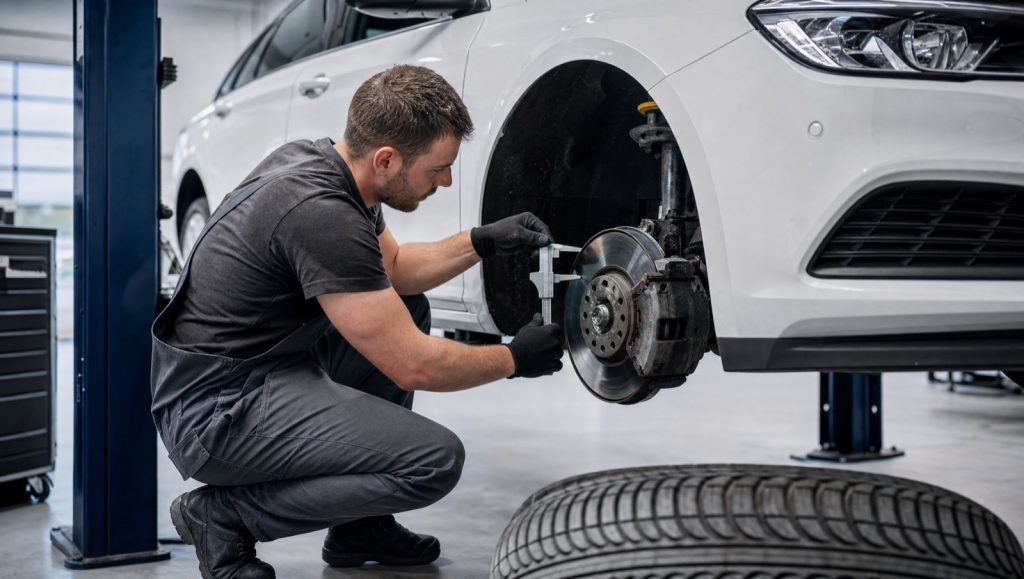
A pre-inspection is us going through the same Transport for NSW standard, rule 101 to rule 107, before your official check, with the car on the hoist at Hotham Parade and the wheels off where needed. You get a written list of anything that would fail, a quote for fixing it, and nothing is done until you approve it.
On a European car, a lot of the likely fixes need more than spanners:
- Rear brake pads on European cars with an electronic parking brake need the diagnostic software to put the calipers into service mode first.
- A replacement battery on many European cars has to be registered to the car so it charges correctly.
- A new windscreen on a car with a camera behind the mirror needs the ADAS system recalibrated, and we do that calibration in-house.
- Clearing an ABS or airbag fault means reading the module that stored it, with factory-grade diagnostic equipment.
While the car is up, we also look at what the inspection doesn’t cover: oil and coolant condition, brake fluid, bushes that are cracked but not loose yet, and the fault memory across every module. None of that changes whether you pass. It does tell you what’s coming in the next twelve months, and you’re the one who decides what to do with it.
Blue slip cars: what usually needs attention first
If your car’s been sitting unregistered for a while, or you’ve just brought it down from Queensland or over from Western Australia, it’ll usually need a few specific things before an AUVIS inspection. Your tyres can have plenty of tread and still be cracked from age. Brake fluid absorbs moisture over time. A battery left on a car that hasn’t been driven is often flat or weak, and on a European car a weak battery can bring up warning lights that have nothing to do with the battery.
Because the blue slip also checks identity and design, it helps if the compliance plate and VIN details are in order and any modifications have paperwork to match. We’ll check the mechanical and safety side before the inspection so the only thing left on the day is the inspection itself.
Booking a pre-inspection in Artarmon
We’re at 1/39 Hotham Parade, Artarmon, a few minutes from Chatswood, St Leonards and Crows Nest, open Monday to Friday from 7am to 5:30pm. You can book online in about two minutes or call 1300 136 825. If you mention your rego expiry date when you book, we’ll plan the timing around it.
Any repair we carry out comes with our 12-month or 10,000 km guarantee, and we use genuine OEM parts, with the part numbers on your invoice.
Common questions
How much does a pink slip cost in NSW?
The inspection fee is charged by the inspection station, and Transport for NSW publishes the current safety check and inspection fees on its website. If the car needs repairs to pass, we quote them before any work starts, and you approve the quote first. If the car fails, NSW rules say there’s no further inspection fee when the repairs are done within 14 days and the car goes back to the same station.
What fails a pink slip in NSW?
The most common reasons are tyres under 1.5 mm of tread, a crack in the windscreen in front of the driver, a light that doesn’t work (including the number plate light), an ABS or airbag warning lamp that stays on, worn steering or suspension parts, and oil leaking onto the exhaust or brakes.
How long does a pink slip last if the car is out of rego?
A pink slip report is valid for six months. If the rego has been expired for more than three months, though, it’s cancelled, and the car needs a blue slip (AUVIS inspection) instead to be registered again.
How long before you need a blue slip in NSW?
Once the registration has been expired for more than three months. A blue slip is also needed for a car coming in from interstate or overseas, a car with no plates, and a repairable write-off approved for re-registration.
What do you need for a pink slip in NSW?
Your renewal notice tells you whether the car needs one. The inspection is done at an Authorised Inspection Station, and when the car passes, the station sends the report to Transport for NSW electronically.
How do I check if my vehicle is due for inspection?
The renewal notice says so. The rule for most light vehicles is a yearly inspection once the car is more than five years old, counted from the compliance plate date.
Can you get a green slip on an unregistered car?
A green slip is CTP insurance, and Service NSW lists CTP among the documents needed to re-register an expired vehicle, alongside the blue slip. Your CTP insurer can confirm how they handle a car that isn’t registered yet.
Do you issue pink slips in Artarmon?
No. Pink and blue slips are issued by authorised inspection stations. We do the pre-inspection and the repairs, so the car goes to the official check ready.
Where can I get car service in Artarmon?
At our workshop at 1/39 Hotham Parade, Artarmon. We service European cars, including Audi, BMW, Mercedes-Benz, Porsche, Volkswagen, Land Rover and Jaguar.
Can I get a pink slip online in NSW?
No. The car has to be inspected in person at an Authorised Inspection Station. Once it passes, though, you won’t need to carry anything: the station sends the report to Transport for NSW electronically.
Can a mobile mechanic do a pink slip in NSW?
Yes, if they’re an authorised pink slip provider. They come to you. The NSW Government notes a call-out fee may apply on top of the inspection fee.
Do I have to get a pink slip every 6 months?
No, it’s once a year. Most light vehicles more than five years old need one at rego renewal, and the six months you’ve heard about is how long the report stays valid after the inspection.
How early can I get a pink slip in NSW?
Check your renewal notice. It tells you when the inspection is due, and the report has to be used to renew within six months, so going much earlier than that doesn’t help. If you’d like a pre-inspection with us first, book it three or four weeks before expiry. That leaves time to order a part.
Which cars don’t need a pink slip in NSW?
Cars under five years old, counted from the month and year on the compliance plate. The NSW Government also exempts caravans under 411 kg tare, trailers under 251 kg tare without brakes, and seasonally registered vehicles with a valid inspection in the last 12 months.