If you drive a European car in Sydney, the most useful thing to know about a workshop is whether it is a genuine European car specialist or a general workshop. Searching “mechanic near me” will not tell you. It returns every workshop within a few kilometres, ranked by proximity and reviews, with nothing to tell you which of them can actually service the car sitting in your driveway.
For a European car that distinction matters more than it does for most. Here are six questions you can ask on the phone, in about four minutes, and what the answers tell you.
1. “Do you have manufacturer-level diagnostic access for my make?”
This is the question that separates the field, and it is worth asking first.
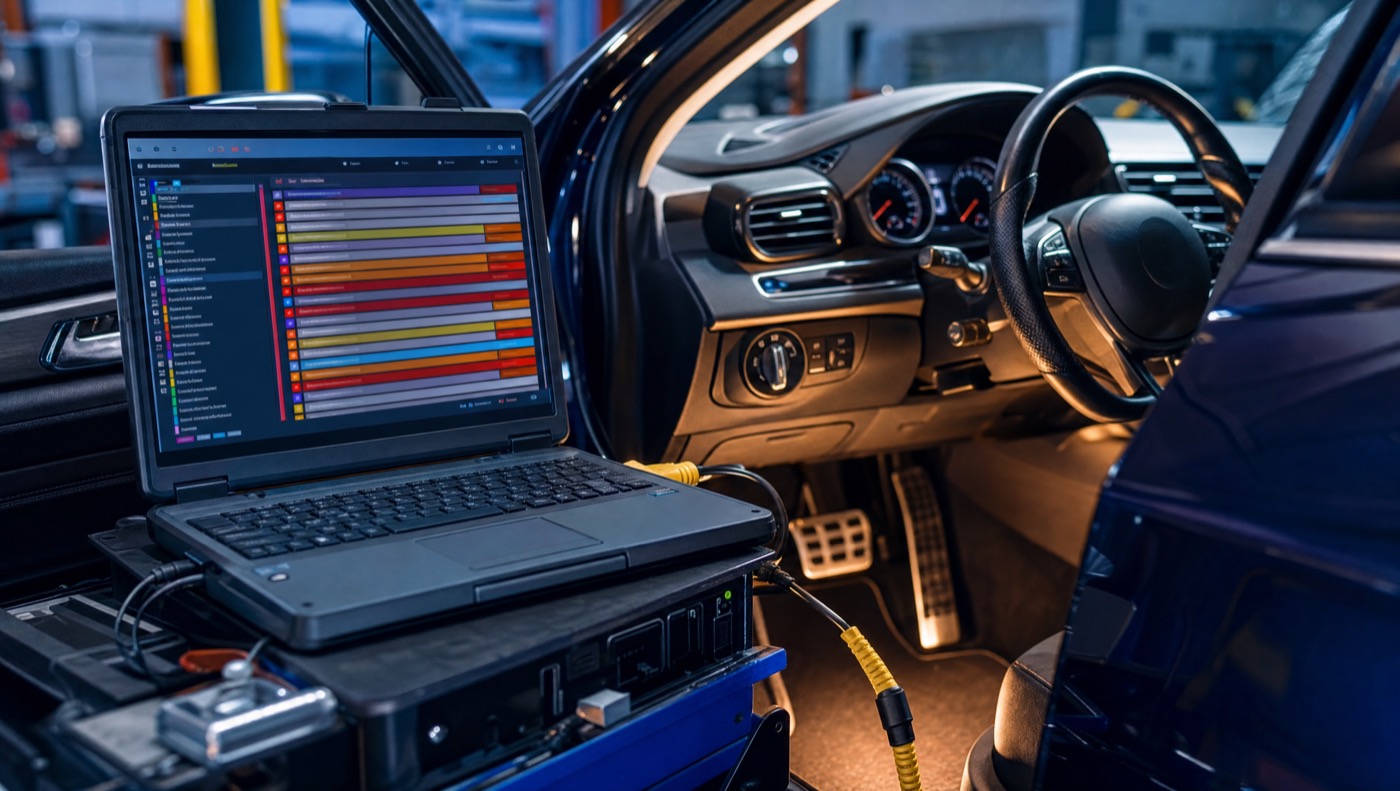
Every workshop has a scan tool. Generic tools read emissions-related engine data, because that is what the law requires manufacturers to expose. On a modern European car, that is a fraction of what is there: the transmission, ABS, airbag, body, comfort, gateway, battery management and headlight modules are all outside it.
Without manufacturer-level access, a workshop cannot read most of your car, cannot reset a service counter properly, cannot register a new battery, and cannot retract an electronic parking brake to change rear pads safely. A good answer names the software. A vague answer about having “a good scanner” is an answer.
2. “How will you retract the rear calipers on my car?”
A specific version of the same question, and a useful one because it is hard to bluff.
If your car has a parking brake button rather than a lever, the rear caliper pistons are motor-driven and must be retracted through the diagnostic system. Wound back mechanically, the actuator is damaged. The right answer is immediate and technical. Hesitation tells you what you need to know.
3. “What oil will you use, and what approval does it carry?”
Not the brand. The approval.
European manufacturers publish approval numbers because their engines demand specific properties: an oil that reaches a turbo bearing on a cold start, that survives extended intervals, that will not poison a diesel particulate filter with ash. An oil can match the viscosity and fail the approval.
A specialist answers with the specification for your engine without being prompted, and puts it on the invoice. “We use good quality 5W-30” is not the same answer.
4. “Will you record the service against the VIN?”
Modern European cars keep their own service history internally. A workshop with the right access writes the event to the car, so the record travels with the vehicle.
This matters twice. Once when a warranty conversation comes up, and once, years later, when a buyer’s inspector reads the car and compares it with the folder you hand over. A gap in the internal record costs real money at resale even when every invoice is present.
5. “How do you quote, and what happens if you find something else?”
The answer you want is: a quote before any work begins, and a phone call before anything outside it is touched.
What that rules out is the workshop that starts, finds “a few other things”, and presents them as done at collection time. It also rules out the opposite failure, the one that quietly leaves items off the quote to win the job and lets you discover them next year.
A specialist should also be willing to tell you what does not need doing. If your pads have five millimetres left, the honest answer is that they have another interval in them.
6. “Who will actually work on my car?”
At a small independent workshop the answer is a name, and often the same person you are speaking to. That continuity is worth more than it sounds, because a technician who has seen your car before recognises what has changed.
It is also the practical difference between the two models. A dealership gives you a service advisor and a rotating workshop. An independent specialist gives you the technician. Neither is automatically better, but you should know which you are buying.
What the answers usually reveal
General workshops are not bad workshops. Many are excellent on the cars they see every day, and a good general mechanic will tell you honestly when a car is outside their equipment.
The failure mode is not incompetence, it is the gap between what the car needs and what the tools can reach. That gap produces predictable outcomes: a service light that cannot be reset properly, a battery that fails in a year because it was never registered, a rear brake job that damages an actuator, a fault chased by replacing parts because the live data was never visible.
None of those are catastrophic on their own. Together they are why European cars get a reputation for being expensive to run, when what actually happened is that they were serviced by equipment that could not see them.
Two questions that are not worth asking
“Is it cheaper than the dealer?” Almost always yes, and it tells you nothing about whether the work is right. What you want to know is what is included, and what specification the parts are.
“Will it void my warranty?” Worth knowing, but the answer is settled law rather than a matter of opinion. Under Australian Consumer Law a manufacturer cannot require you to service at their dealership to keep the factory warranty valid, provided the schedule is followed, the parts meet specification, the work is done by someone qualified and it is documented. Any workshop that is vague about this is telling you they do not do all four.
What a specialist does in-house
Some jobs show quickly whether a workshop is set up for European cars. Battery registration on BMW and Mercedes-Benz. Electronic parking brake service mode. Coding a new module or headlight to the car. DSG fluid filled at temperature with the adaptations reset. ADAS calibration after a windscreen, alignment or suspension job, which many workshops send out and we do in-house. Each one takes minutes with the right access and becomes a problem without it.
Independent, not the dealership
The other comparison people make is with the dealership, and it is a fair one. A dealership has the equipment and the training for its own brand, and for some warranty repairs it is the right place to go.
For servicing and most repairs, a European specialist answers the same six questions the dealership would, with one difference in how the work reaches you. At an independent workshop the quote comes from the person who will do the job, the evidence for anything extra comes on the phone before the work, and the schedule is read from your car rather than from a menu. Your factory warranty is unaffected as long as the schedule, the parts and the record are right.
A specialist also covers more than one brand under the same roof. For a household with a BMW and a Volkswagen in the driveway, or a Mercedes and a Land Rover, that means one workshop that knows both cars.
What we would answer
We are an independent European workshop in Artarmon, five minutes from Chatswood, St Leonards and Crows Nest, and not a dealership. Manufacturer-level diagnostic access for the makes we specialise in, every module. Genuine or OE parts with the numbers on the invoice, fluids to the exact approval. The service written digitally against the VIN. A quote before anything is touched and a phone call before anything outside it. Manufacturer-trained technicians, and the person who quotes your car is the person who works on it.
Every job carries our own 1 year / 10,000 km workshop guarantee, on top of your factory cover. The full list of what we do is on the Sydney services page, and if you want to see the workshop and the address first, that is on the Sydney page.
Common questions
Is an independent specialist really as good as the dealership?
On the work itself, when the equipment, the training and the parts specification match, yes. What changes is the labour rate and who you deal with.
My car is still under factory warranty. Can I use you?
Yes, and we do it every week. The law protects your right to choose, provided the schedule, the parts and the documentation are right, which is how we work anyway.
What if my car is a make you do not list?
Ask. We specialise in European makes and if your model is outside what we can properly support, we will say so rather than learn on your car.
How far ahead do I need to book?
We are by appointment only, and most weeks have same-week availability. Booking a few days out gives us time to have the right parts on the shelf.
Which European brands do you service?
BMW, Mercedes-Benz, Audi, Volkswagen, Porsche and Land Rover, with manufacturer-level diagnostic access for each.